



A row of dark-sided single-story houses with gabled shingle roofs behind a long trimmed hedge, with mown lawn in the foreground and large leafy trees overhead under an overcast sky.

Furnace Maintenance in Zionsville, IN

Tell us about the job

Takes about a minute. No obligation.

Tune-up, service, or cleaningFurnace or heatingBoone County, IN
Step 1 of 2

What ZIP code is the job in?

Furnaces in Boone County start working in October and keep going through May. That's eight months of runtime on one system. September is the month to get it checked, right before it has to carry that load. A technician can catch a weak igniter or a cracked heat exchanger while the furnace is still sitting idle, not after it's already struggling through a cold week. Wait until October and you're booking the check at the same time the furnace is trying to prove itself.

A cracked heat exchanger won't smell like gas or trip an alarm until it's bad.

A tune-up checks it while it's still a small crack, not a reason to shut the furnace down.

Half these furnaces are still young enough that upkeep is what keeps them that way

Half the homes here were built by 1995
Heat runs October through May
Winter nights average 21°F

Most furnaces in Boone County run on utility gas, close to six in ten homes. A gas furnace needs a flame to burn clean and a vent to carry the exhaust out of the house. Maintenance on one of these means checking the burner, the flame sensor and the venting, not just swapping a filter. Electricity heats roughly a third of homes here, and those heat pumps or electric furnaces have their own checks, mostly around the coils and the electrical connections. If your furnace runs on propane, the same burner and venting checks apply, since propane burns the same way gas does. Whatever the fuel, the point of the visit is to confirm the parts that could fail are still working the way they should.

A yearly check keeps a newer furnace newer, longer

Half the furnaces in Boone County are running in homes built in 1995 or later. A furnace that age has years ahead of it. A yearly check is what keeps the igniter and the heat exchanger working the way they should through all of them, instead of finding out about a problem only after it fails.

Find a contractor
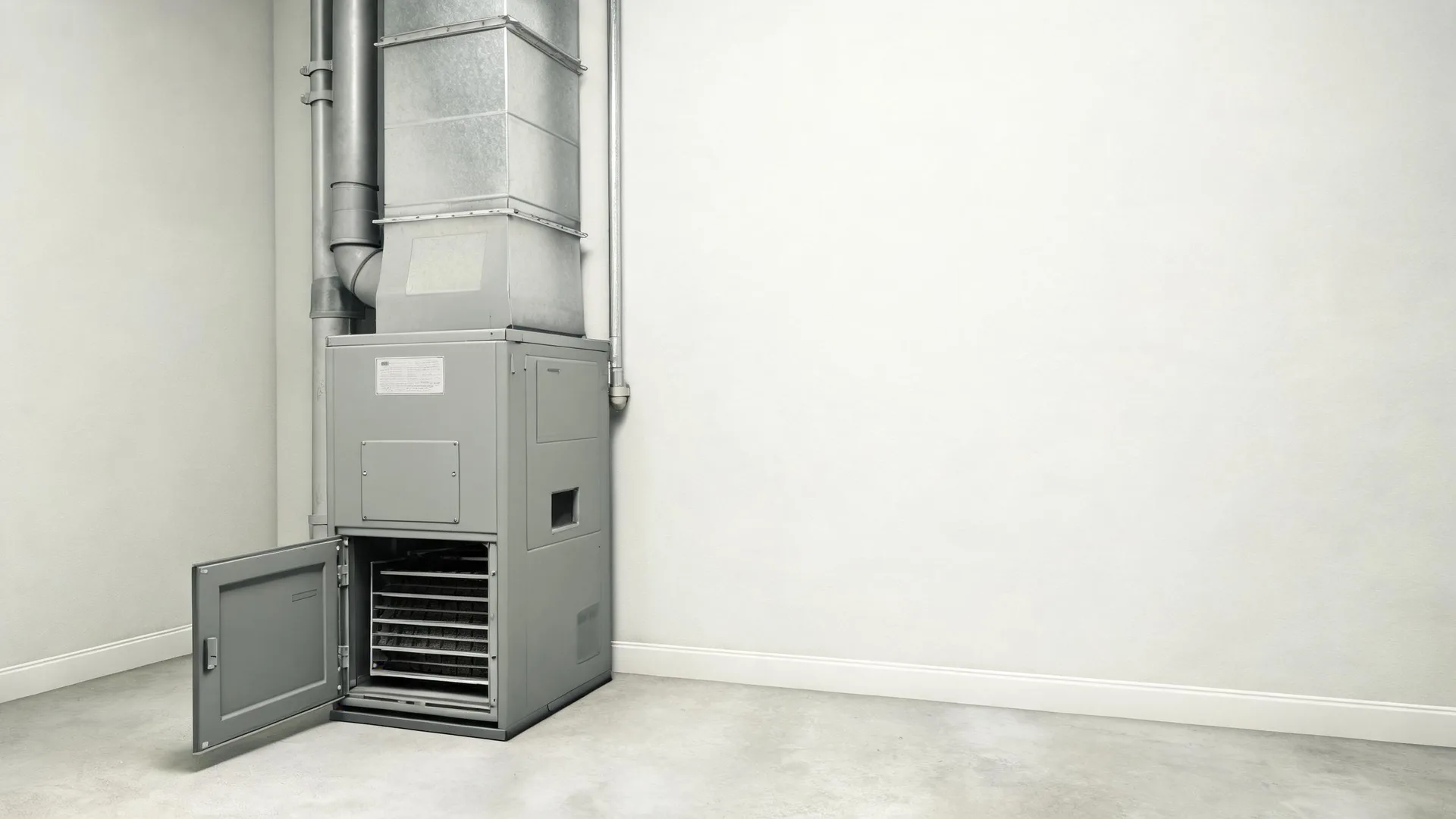
A gray residential gas furnace installed in an unfinished basement, surrounded by ductwork, a metal flue pipe, and a gas supply line.

A filter or a coil doesn't fail in a week. It fails over a winter.

A furnace filter sits in the path of every bit of air the blower moves. Once it loads up with dust, the blower has to work harder to pull air through it. The heat exchanger behind it runs hotter than it should. A dirty coil causes the same kind of strain from the other side. It traps heat that's supposed to transfer and move on instead. Neither failure happens fast. It happens one month at a time, and a long winter gives it plenty of time to do that. The condensate drain matters for the same reason. A furnace that runs for months straight needs that line clear the whole time, not just on the first cold day, or the water backs up into places it was never meant to sit.

A dirty flame sensor shuts the furnace down, not just down low

The flame sensor tells the control board the burner actually lit. Once it's coated with a film, it stops reading the flame at all, and the board shuts the gas off rather than let it run without proof of combustion. The furnace does not limp along in this state. It stops, usually on the coldest night it's been asked to run.
A neglected furnace still starts. It just starts wrong

Skipped maintenance rarely shows up as a furnace that won't turn on. It shows up as one that short cycles, runs longer than it should to reach the same temperature, or kicks its blower on and off in a way it didn't used to. Those are signs of a system working around a problem instead of one that's about to quit.

A furnace usually tells you before it quits. The blower runs but the air coming out feels cooler than it used to. The burner flame looks ragged or yellow instead of steady and blue. The furnace clicks on, shuts off, then clicks back on again a few minutes later, a sign it's starting and stopping without finishing the cycle it's supposed to run. A rattle in the blower compartment or a smell when the furnace first fires are both worth a look. None of these mean the furnace is about to fail outright. They mean something inside it is already working harder than it should, and a check before winter is what catches which part that is.

A tune-up starts before the furnace is ever opened up. A technician checks the thermostat calls for heat correctly, then moves to the burner assembly to look at flame shape and color. The igniter gets tested under load, not just glanced at, since a hot surface igniter can look fine sitting cold and still fail to reach temperature when it's asked to fire. Gas pressure gets checked at the valve, because too much or too little changes how clean the burner runs. The blower motor and wheel get inspected for dust buildup and checked for free movement, since a wheel caked with debris throws off the airflow the whole system was designed around. Electrical connections get snugged down, since a loose wire under a furnace running for months is a wire that eventually arcs or fails. Last comes the heat exchanger, checked for cracks or corrosion while the furnace is cold and still, which is the only time that kind of damage is safe to find.