






Heat pump making a loud noise in South Bend, IN

RepairHeat PumpSt. Joseph County, IN
Step 1 of 2

What ZIP code is the job in?

A loud noise from your heat pump usually points to one of a few things. A banging or clanking often means a loose part inside the outdoor unit, sometimes a fan blade that has come loose or hit ice buildup. A buzzing can mean an electrical issue, like a failing contactor or capacitor. A screeching or squealing points to the fan motor bearings wearing out. In St. Joseph County, winters are hard enough that outdoor units ice over more than homeowners expect, and ice against a spinning fan is a common source of banging noises here. A rattling sound, meanwhile, is often just debris or a panel that has worked itself loose over time. None of these are safe to ignore. A heat pump that is straining to run with a bad part can stop heating your home altogether in the middle of a cold snap, and a part left to fail can damage the compressor, which is the most expensive piece to replace.

A gray outdoor condenser unit on a concrete pad beside a house with stacked stone and horizontal siding, surrounded by gray gravel and a plain light wall.

Ice buildup makes the sound worse

When a heat pump runs its defrost cycle, a reversing valve shifts and the outdoor fan can pause or slow. If ice has already built up on the coil or around the fan blade, you'll hear it as a knock or scrape right as the cycle changes. That ice usually points to a drainage problem or a refrigerant charge that's off, not something that clears on its own by spring.

A dark gray outdoor heat pump unit sits on a concrete pad beside a white stucco wall and lap-sided house corner, with mulch and a small shrub in the foreground.

Compressor noise means something different

A heat pump's compressor sits inside the outdoor cabinet and runs anytime the system calls for heat or cooling. A hard rattle or a high-pitched whine from that cabinet, rather than from the fan up top, often traces back to the compressor itself or the mounts holding it in place. That's a different repair than a loose fan blade, and worth telling the contractor when you describe the sound.

Call Now or Keep Listening

Call for repair now

  • A grinding or screeching sound from the outdoor unit usually means a bearing is failing, and the motor can seize if it keeps running.
  • A loud bang when the system starts or stops often means a part has broken loose and is hitting the fan blade or housing.
  • If the noise comes with the unit tripping its breaker or shutting off on its own, something electrical needs a look before you run it again.
  • A noise that's gotten louder over a few days, not weeks, usually means whatever's loose or failing is getting worse fast.
  • If you smell anything burning along with the noise, that's a sign to shut the system off and get someone out rather than wait.

Safe to watch for now

  • A knock or scrape during defrost, when ice has built up on the coil or fan blade, often clears up once the ice melts off.
  • A faint hum or clicking when the compressor or fan cycles on is normal for most heat pumps and isn't a sign of a problem.
  • A rattle that only shows up in high wind is sometimes just a loose panel screw you can snug down yourself.
  • If the sound is quiet, hasn't changed in weeks, and the unit is heating and cooling the way it should, it's worth noting but not urgent.
  • A new sound right after a storm is worth a look for debris in the outdoor unit before assuming a part has failed.
A gray-haired man in a dark green sweater sits on a sofa in a sunlit living room, looking off to the side, with a framed landscape painting, dining table and shelving behind him.
A gray-haired bearded man in a dark green collared sweater sits on a sofa in a living room with a window, houseplant, floor lamp and bookshelves, looking off to the side.
A middle-aged man in a dark green sweater sits on a light grey sofa looking toward a sunlit window, with a wooden shelving unit, lamp and potted plants in the background.
A gray-haired bearded man in a dark knit sweater sits on a light gray sofa in a sunlit living room, looking to his left, with a framed artwork, a potted palm, and a curtained glass door behind him.

Is this noise something to worry about tonight?

You're probably hearing it from inside the house, maybe through a wall near the outdoor unit or whenever the system kicks on or shuts off. A rattle that comes and goes with the wind is different from a grinding that's there every cycle. If it's gotten louder over a few days, or if you've noticed the heat pump running longer than it used to, that's a part wearing down, not settling in. Left alone, a loose blade or a failing bearing can take out the fan motor, and in St. Joseph County winters, losing the heat pump means leaning on backup heat you weren't planning to pay for.

A gray outdoor condenser unit on a concrete pad beside a house with horizontal lap siding, a conduit and disconnect box on the wall, a shrub with white flowers at right and evergreen foliage at left.

Running clean

This is a heat pump that isn't telling you anything. The cabinet is clear, the coil fins get full airflow, and the fan spins without catching on anything. In St. Joseph County winters, a unit running like this keeps up with the demand instead of straining against it.


An outdoor air conditioning condenser unit with a top fan grille sits on a concrete pad beside a house with horizontal siding and a concrete step.

Fins caked with debris

Dust and yard debris have packed into the coil and the grille until airflow has to fight its way through. A unit working this hard runs longer, pulls harder on a power bill that's already expensive here, and gives the fan motor and moving parts more reason to wear down and start making noise.

A man in a blue sweatshirt and cap carries a red and black tool bag up a paved walkway toward a house entrance where another man in a tan sweater stands in the open doorway, with stone-clad columns, wall lights, and potted mums nearby.

Why the noise changes with the weather

A heat pump works harder than a plain air conditioner because it runs both directions, pulling heat from the outside air even when it's cold out. That outdoor unit has a reversing valve that switches the refrigerant flow between heating and cooling, and that valve makes its own sound when it shifts, a solid thunk you'll notice most on cold mornings when the system has been heating all night. A compressor that's working hard in single-digit weather also runs louder than it does in April, because it's moving more refrigerant to pull heat out of colder air.

None of that tells you on its own whether the noise is normal strain or a part starting to fail. A contractor who services heat pumps through St. Joseph County winters hears this difference every season, the regular hum of a unit under load versus the sound of a motor mount working loose or a valve that's sticking. Getting matched with one means someone who knows your make and what tends to go first on it looks at your unit specifically, not a general call center guess.

Interior corner of a room with a window and sheer curtain at left, a gray upholstered sofa with a cushion at right, and a round wooden table holding stacked books and a round vase with an olive branch.
A beige outdoor air conditioning condenser unit on a concrete pad beside a house with horizontal vinyl siding, with refrigerant lines and a disconnect box on the wall, surrounded by dark mulch and a green shrub at left.

Sitting right where it belongs

The unit sits level on its pad, the conduit runs clean to the disconnect, and nothing around it is rattling or catching. A heat pump like this hums along and shuts off quiet. You walk past it and don't think about it.

An outdoor air conditioner condenser unit on a concrete pad beside a house with horizontal lap siding, with a shrub to the left, bare dirt in front, and conduit and a metal disconnect box on the wall.

Something's off here

Same setup, same kind of unit against the house, but this one's worth a second look. If it's grinding, banging, or buzzing when it cycles on or off, that's a part working loose or a motor under strain, not normal wear you can wait out.

An outdoor air conditioning condenser unit on a concrete pad beside a house with horizontal siding above a brick foundation, with a flexible conduit running to a wall-mounted disconnect box.
Before you get your heat pump repair
An outdoor condenser unit on a concrete pad beside a gray lap-sided house, with an electrical disconnect box and conduit on the wall and shrubs with mulch to the right.
After you get your heat pump repair
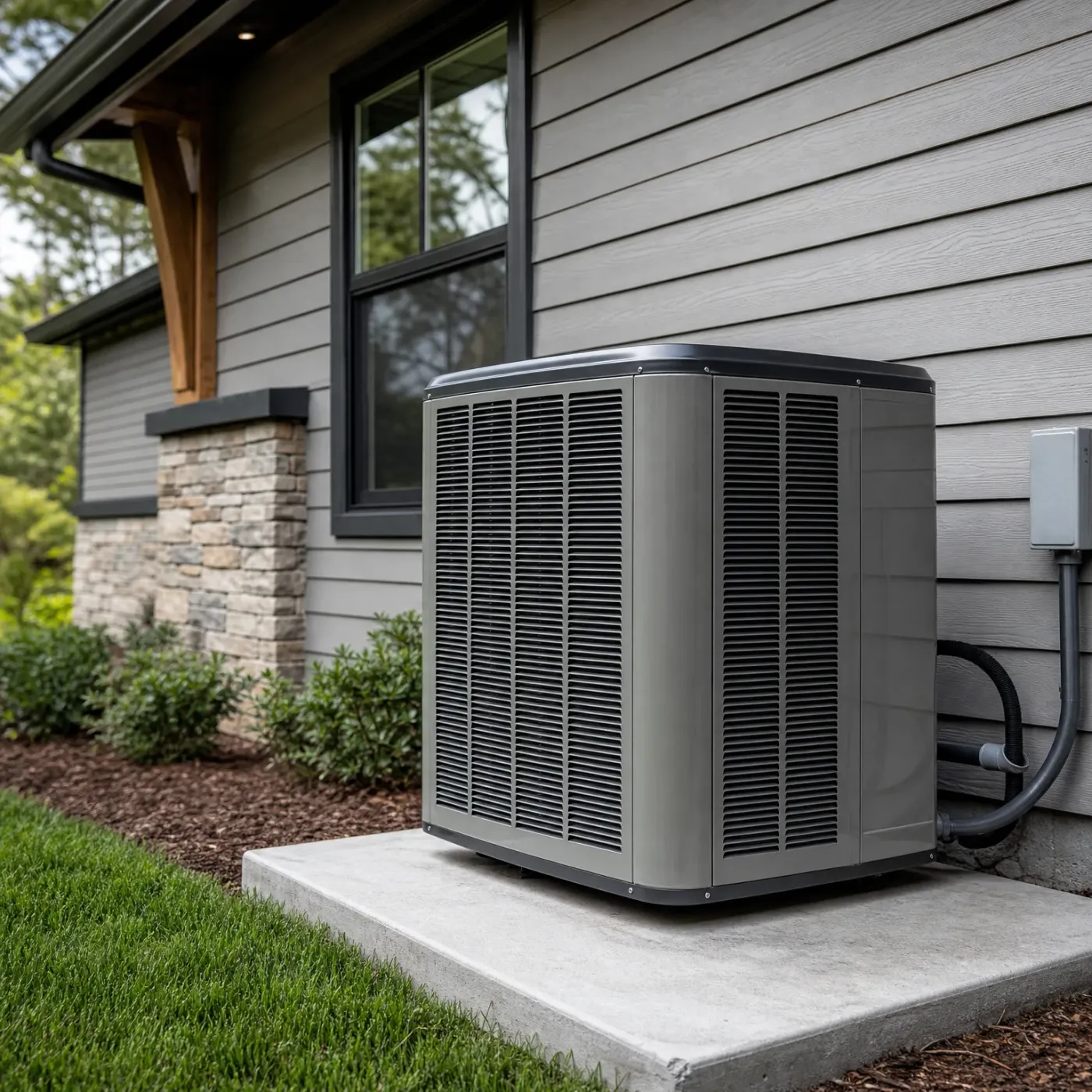
A gray outdoor condenser unit on a concrete pad beside a house with horizontal lap siding, a stone-veneer column, dark-framed windows, shrubs and mulch, and a lawn in the foreground.

A pro who works on heat pumps

Only one pro gets your request, so you hear from one company.

A local pro who knows heat pumps gets your details and gets in touch.

Reach a local pro

No charge to send it. You decide if you hire them.

A gray outdoor condenser unit on a concrete pad beside a light-green sided house, surrounded by mulch, ornamental grasses and a shrub, with mowed lawn in the foreground.
A unit like this sits clear of mulch buildup and spins free, so you only notice it when a neighbor points it out.
A gray outdoor air conditioning condenser unit on a concrete pad beside a house with light vinyl siding, with a gray electrical disconnect box and conduit on the wall to the right.
Caked fins and dirt like this muffle airflow and strain the fan motor, which is often where a new noise starts.

Most of what you hear traces back to something small working loose. The outdoor fan motor rides on rubber grommets, and once they wear out the motor shakes the cabinet around it instead of spinning clean. The compressor itself runs with a steady hum, so a hiss or rattle near it usually means a mount gave way or a line shifted, not that the compressor is failing. Those refrigerant lines pass through the cabinet wall through a grommet, and if that grommet slips, bare copper touching sheet metal will buzz with the vibration. The reversing valve gives one click when it switches between heating and cooling. That single click is normal. A repeating clack is not. Sheet metal panels are held on with screws, and it only takes a few backing out for the whole cabinet to rattle at certain fan speeds. Screeching is the one to take seriously. It means metal on metal, either a bearing running dry or a fan blade that has shifted and is clipping the shroud around it.

Where these sounds come from

  • The outdoor fan motor sits on rubber grommets, and once those wear out the motor shakes the whole cabinet when it spins.
  • A compressor makes a steady hum inside the unit, so a new rattle or hiss around it usually means a mount or a line has come loose.
  • Refrigerant lines run through a grommet where they pass through the cabinet wall, and if that grommet slips a line can touch bare metal and buzz.
  • The reversing valve clicks once when it switches the system between heating and cooling, which is normal and different from a repeating clack.
  • Sheet metal panels on the cabinet are held with screws, and a few backing out is enough to make the whole unit rattle at certain fan speeds.
  • A screeching sound almost always means metal on metal, which is either a dry bearing or a fan blade that has shifted and is clipping the shroud.
A woman with shoulder-length blonde-grey hair in a light knit cardigan sits in a grey upholstered armchair, looking toward a window, with a bookshelf and a small potted plant behind her.
A woman and a child with closed eyes rest together on a gray couch, wrapped in a cream knit blanket, with a lit lamp and houseplant blurred in the background.

Power here costs 16.62 cents per kilowatt-hour

At 16.62 cents per kilowatt-hour, a heat pump that's straining to run, whether from a worn fan motor or ice that keeps building on the coil, shows up fast on your bill. A loud noise is often the first sign something is pulling more power than it should.

EIA-861 2025

  1. A technician listens with the unit running to place the sound

  2. They check the outdoor fan blade and motor mounts for play

  3. They inspect the compressor mounts and refrigerant lines for contact

  4. They clear ice or debris that's making the sound worse

How much work does your heat pump do here?

  • Winter nights average 20°F

    Your heat pump runs from October through May here, about eight months of the year, per local weather data. A loud noise isn't a short-term problem you can put off until spring.

  • Heat runs October through May

    Winter nights in St. Joseph County average 20°F. At that temperature your heat pump is pulling double duty, and a part already under strain is more likely to fail outright.

  • Cooling runs June through August

    Cooling only runs June through August here. The other eight months, your heat pump is the only thing keeping the house warm, so a new noise now matters more than it would in July.

NOAA nClimDiv 1991-2020

What the noise comes down to

  • A loud noise from your heat pump almost always traces back to a loose fan blade, worn motor mounts, ice buildup, or a compressor that's come unmounted.
  • Letting the noise continue while the unit keeps running can turn a worn part into a seized motor or a cracked line.
  • A technician who works on heat pumps in St. Joseph County every winter knows which of these sounds to check first and which ones mean shut it off now.
  • You get matched with one licensed local contractor, so you're not fielding calls from several companies while you're trying to figure out what's wrong.
  • The same noise can mean something minor in October and something urgent in January, so when you hear it matters as much as what it sounds like.
  • Once the loose part, worn motor, or ice is addressed, the unit should go back to running quiet through the rest of the season.

A loud noise from your heat pump is the unit telling you something specific, not a reason to turn up the TV and wait it out. A loose fan blade, worn motor mounts, ice on the coil, a compressor that's shifted off its mounts. Each one sounds a little different, and each one gets worse the longer the unit keeps running on it. A fan blade catching on ice can bend. A motor shaking on worn mounts can burn out. A compressor line rubbing against the cabinet can crack. None of that happens overnight, but none of it fixes itself either.

What changes the outcome is who looks at it and how fast. Someone who services heat pumps in St. Joseph County through a full winter has heard this exact sound before, in a unit just like yours, and knows whether it's a ten-minute fix or a sign to shut the system down until it's looked at. That's different from a general handyman guessing at it once.

When you ask for help here, you're matched with one licensed contractor local to the area, not a list of five companies calling you back at once. You explain the noise once, to someone who already knows what it usually means in a heat pump running through a Michiana winter. Get the loose part secured, the ice cleared, or the mount replaced, and the unit goes back to running the way it should: quiet, through the rest of the season.

Interior corner showing a white painted column with paneled trim and chair rail meeting a wall with baseboard, beside light wood cabinetry with black bar pulls and a ceramic vase, over dark hardwood flooring.
Interior corner with a white-framed window showing green foliage, a pale wall with baseboard, light oak plank flooring, and a wooden cabinet with a dark ceramic vase on top.
A rustic wooden bench against a pale wall holds a weathered ceramic vase with leafy branches, below a black cone wall sconce, beside a window with sunlight falling on the wood floor.
A bathroom vanity with wood cabinets and a white marble countertop, black widespread faucet and undermount sink, a wood-framed mirror, a fabric-shaded wall sconce, a ceramic vase with green branches, and a window with white blinds.
Empty room corner with taupe walls, white wainscot paneling, crown molding, dark wood floor, and a double-hung window showing green foliage outside.

Get your heat pump to the right pro

A licensed pro who works in St. Joseph County gets your request.

Find a licensed heat pump pro

There's no charge for the request.