May is when weak parts get found
Heat pumps in Noble County switch over to cooling in June after sitting idle. A capacitor or contactor that was already marginal often won't make it through that first startup.
Takes about a minute. No obligation.
Heat pumps in Noble County switch over to cooling in June after sitting idle. A capacitor or contactor that was already marginal often won't make it through that first startup.
Heat kicks on in October and runs for eight months straight here. A heat pump that struggled at the end of last winter will show the same trouble again as soon as it's asked to work.

NOAA nClimDiv, 1991–2020 normals
Your heat pump isn't fighting extreme heat in Kendallville, since summers here don't push it hard.
A unit that's been maintained usually has life left, so a repair is worth calling in most cases.



Half the houses in Noble County were built in 1976 or earlier, half in 1976 or later, and that split doesn't change what's wrong with your heat pump. An old house and a new one both run the same kind of unit, with the same compressor, reversing valve and defrost board, and they fail the same way. Nobody here is dealing with a harder repair just because of when their house went up. What matters more is what the unit has been doing lately. One that iced over and didn't clear itself, or struggled the first time it had to switch modes, is telling you something specific, and a tech can trace it to one part instead of guessing.
Winters here average 20°F overnight, and that's the load your heat pump actually deals with, not extreme cold, not extreme heat. A unit that's been getting by hasn't been fighting the system to do it. If it's icing over, short cycling, or not switching modes clean, that's one part wearing out, not the whole thing giving up. Worth getting a tech to trace it down.
Find a contractorCheck the thermostat before anything else. Set it to heat and push the temperature up past room temperature. It should kick on within a minute. If nothing happens, check the breakers, the one for the outdoor unit and the one for the air handler, since either one tripped looks like a dead system. Pull the air filter and hold it to a light. If light barely gets through, that filter is choking airflow and making the system work harder than it should. A fresh filter is the one thing worth swapping before a tech ever shows up. Walk through and check that no vents are closed or blocked by furniture. Look at the outdoor unit. Some frost on the coil in cold weather is normal and clears on its own during a defrost cycle. Ice that stays for hours and doesn't thin out points to the defrost board or reversing valve, and that's not something to chip at or hose off. Listen at the outdoor unit too. A hum with no fan spinning usually means a failing capacitor, not something to test or swap yourself. If the thermostat, breakers, filter and vents all check out and it still isn't running right, that's the point to stop guessing and get a tech out.
A compressor straining to start draws more current every time it tries, and each hard start heats the windings a little more than the last. Left running, it gets to the point where the overload trips every cycle, or the windings short. What started as sluggish becomes a compressor that won't start at all.
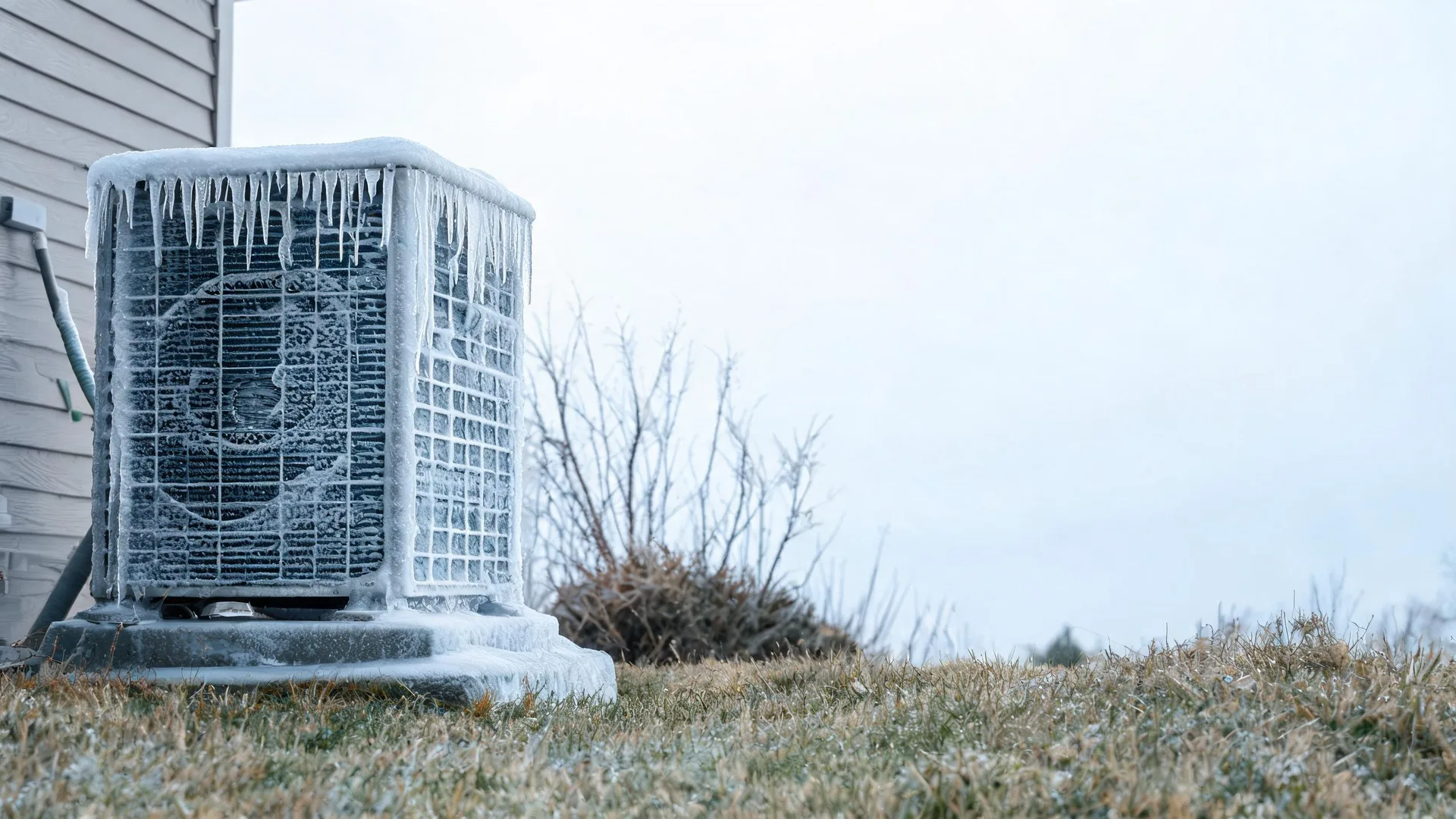
A heat pump that isn't defrosting right builds frost, and that frost blocks airflow across the coil, and blocked airflow makes defrosting even harder next cycle. Left alone, the coil ices solid, the system loses its heat source, and it ends up running the outdoor fan against a block of ice until something gives.
A heat pump in trouble usually says so through sound and feel before it quits outright. Air coming out the vents that's gone lukewarm, when it used to feel warm, means it's losing the fight somewhere in the cycle. A clicking that repeats without the outdoor unit ever starting is a contactor trying and failing to close. Warm air that only runs for a couple minutes before shutting off, then starts again shortly after, is short cycling, and it points to a limit switch tripping or airflow that's choked somewhere. A smell like something burning or scorched dust when it first kicks on after sitting is worth shutting the system down for, not running through. None of these mean the whole unit is done. They mean a specific part is failing, and the longer it runs in that state, the more it drags down whatever's next to it.
A diagnostic visit starts before any panel comes off. A tech runs the system in the mode it's been struggling with and watches what it actually does, not what it's supposed to do. Pressures get checked at the service ports, since a low charge or a stuck metering device shows up there before anywhere else. The capacitor gets tested under load, not just looked at, because a weak one can still look fine sitting still. If icing was the complaint, the defrost board gets checked on its own, since that cycle runs on a timer and a sensor, not a guess. Each reading either clears a part or points straight at it, and that's what tells the tech which one to replace instead of which ones to swap and hope.