A row of dark gray single-story houses with asphalt shingle roofs behind trimmed hedges and a mown lawn, framed by overhanging tree branches under an overcast sky.

Heat Pump Repair in Muncie, IN

Tell us about the job

Takes about a minute. No obligation.

RepairHeat PumpDelaware County, IN
Step 1 of 2

What ZIP code is the job in?

September is when a weak heat pump gets found out

Heat in Delaware County starts running in October, so September is when a heat pump has to switch over and start carrying the load. A unit that limped through on a tired capacitor or a low charge usually shows it in these first weeks, before the cold really sets in.


June does the same thing in reverse

Homes here run cooling from June through August, and that first hot stretch in June puts a different strain on the same machine. If a heat pump struggled at either end last year, getting it looked at before the switchover means it's sitting idle, not already failed on you.

8 months
October through May, your system heats
3 months
June through August, it cools
22°F
the average winter night it heats against
83°F
the average summer afternoon it cools against
Isometric line illustration of a cutaway house showing interior rooms with furniture, a furnace or air handler with overhead ductwork, and an outdoor condenser unit connected by lines outside the wall.
Your system heats October through May and cools June through August.

NOAA nClimDiv, 1991–2020 normals

A heat pump blowing air that doesn't feel hot isn't always broken. That air runs cooler than a furnace's even when the system is working fine.

What points to a real problem is the pattern. It runs without catching up to the thermostat, or it cycles on and off more than it used to.

Half the homes here were built by 1967, old enough for a heat pump to be on its last years

Half the homes here were built by 1967
Climate zone 5A
Power costs 14.77 cents a kWh statewide
Running it broken costs more in IndianaElectricity here ran 14.77 cents per kilowatt-hour in 2024, and a struggling heat pump burns through more of it

Delaware County asks less of a heat pump than most places it gets installed. Winters here are cold enough to rate zone 5A, but the overnight low only averages 22°F across December, January and February, which is well short of the deep cold that pushes a heat pump into its hardest stretch of running. Less strain over the years means a unit that's been maintained is often still in good shape mechanically, even if something in it has failed. That changes the math on repair. A compressor or a reversing valve that hasn't been worked hard for a decade is usually worth fixing rather than replacing. The weather here hasn't been the problem. Whatever's wrong is more likely a part that failed on its own than a machine that's simply worn out from the job it's had to do.

Find out how much life is left before you fix it

If your heat pump came with a house built in 1967 or earlier, ask whoever looks at it how much life is left in the unit before you commit to the repair. One that's been maintained is often still sound mechanically, and worth fixing rather than replacing.

Find a contractor
A man in a cap, dark jacket and tan work pants climbs porch steps toward a blue front door, carrying a canvas tool bag in his right hand, with a potted shrub beside the entry.
A residential heat pump outdoor unit mounted on a concrete pad next to a house with gray vinyl siding.

What actually breaks in a heat pump

A heat pump runs on a reversing valve a furnace never needs, and that valve is a common point of failure. It switches the refrigerant flow so the unit can heat instead of cool, and when it sticks, the system either stops heating or gets stuck in one mode. The compressor itself usually fails from running low on charge for a long stretch, not from age on its own. A slow refrigerant leak lets the compressor run hotter than it should, and that wear adds up quietly until it seizes or trips out. Capacitors weaken over time and show up as a unit that hums but doesn't start, or a fan that spins slow. Outdoors, the defrost board and sensor can fail, and when they do the coil frosts over and never clears, choking off airflow until the system can't keep up.

A low charge gets worse while it runs

A refrigerant leak doesn't heal itself. Every hour the compressor keeps running on a low charge, it's working hotter than it should, and that heat wears on the windings and the bearings. What started as a slow leak you could have caught early turns into a seized compressor if the unit keeps cycling on it.

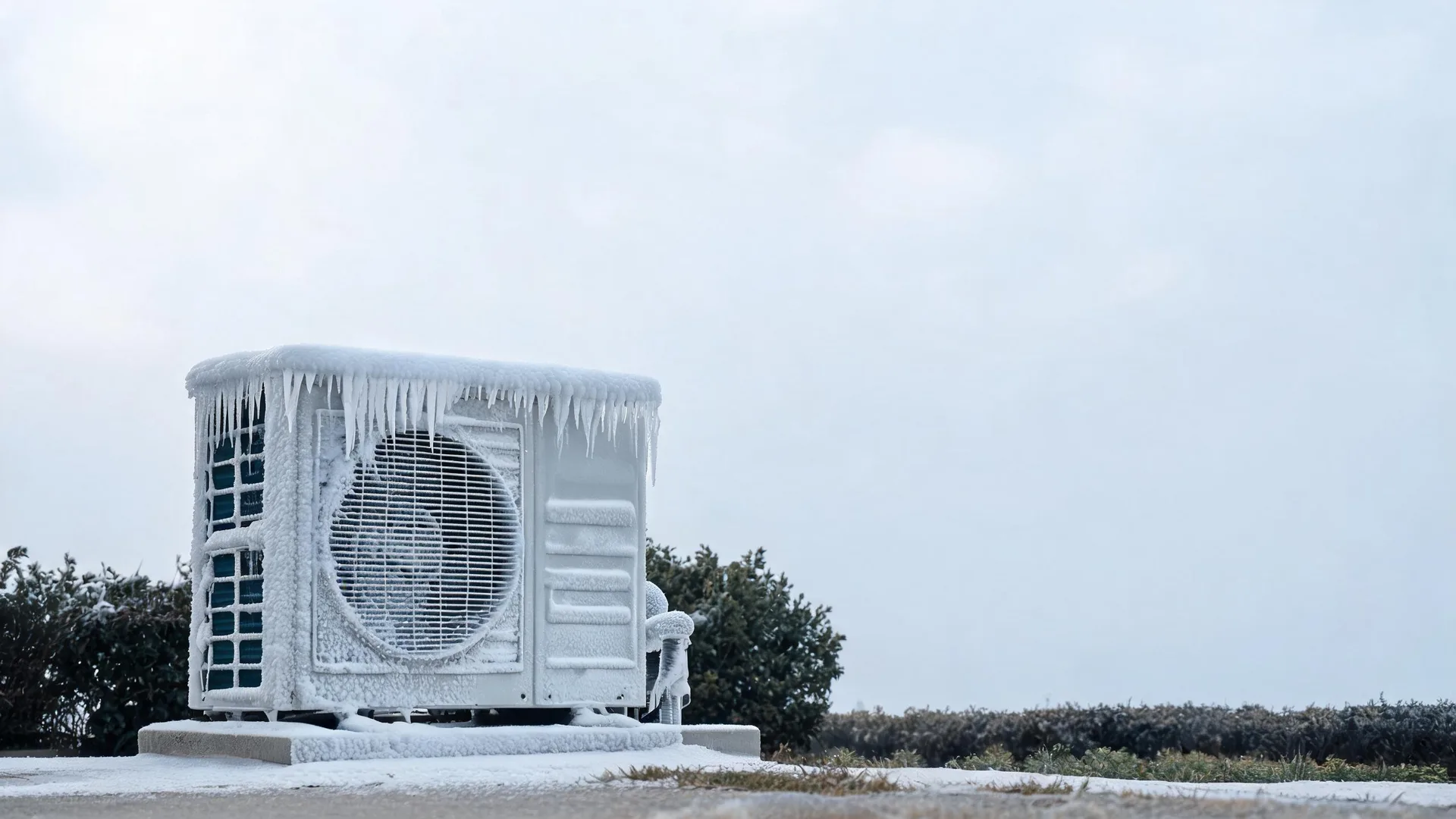
A frosted coil chokes off its own airflow

When the defrost board or sensor fails, the outdoor coil frosts over and never clears. The system keeps trying to pull heat through ice, so it runs longer to do less, and that extra runtime is what pushes a bad board into a dead compressor. Shutting it down when you see solid frost buys the part time it doesn't have while it keeps running.

Before you call anyone, there are a few things worth a look. Check the thermostat is actually set to heat and the temperature is above room temperature, since a setting bumped by accident looks exactly like a dead system. Go outside and check the outdoor unit isn't buried in leaves or boxed in by anything blocking airflow around it. Look at the coil. If it's covered in solid ice rather than a light frost, shut the system off at the thermostat so it stops trying to run through it. Check the air filter, because a filter clogged with dust chokes the airflow the same way a frosted coil does, and it's the one part of this system you're meant to handle yourself. Check the breaker box for a tripped breaker before you assume the worst, since a unit that won't turn on at all sometimes just needs that reset. None of this fixes a bad capacitor or a stuck reversing valve, but it rules out the simple stuff first.

A diagnostic starts outside at the unit itself, checking refrigerant pressures and looking at the coil and the fan before anything gets opened up. Inside, the tech checks the air handler, the filter, and what the thermostat is actually calling for versus what the system is doing. Electrical readings on the compressor and capacitor show whether those parts are pulling power the way they should, since a weak capacitor often shows up in the numbers before it fails outright. If the system won't switch between heating and cooling, the reversing valve gets tested directly rather than guessed at. The point of all this is to find the one part that's actually failed, not to start swapping parts and see what helps.