







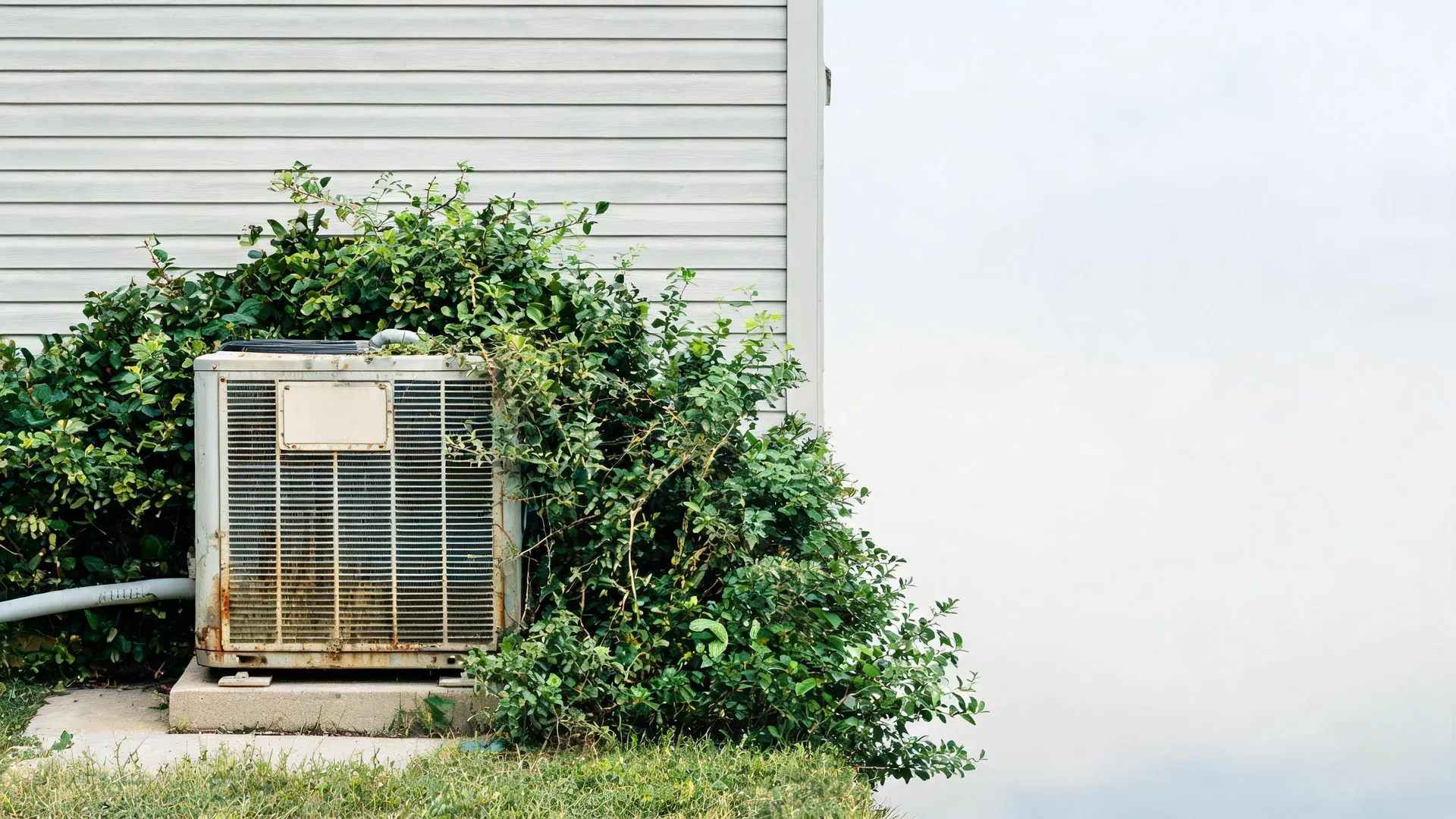
A grey outdoor HVAC unit mounted on a concrete pad beside the beige-sided exterior wall of a suburban house.

Heat Pump Repair in Seymour, IN

Tell us about the job

Takes about a minute. No obligation.

RepairHeat PumpJackson County, IN
Step 1 of 2

What ZIP code is the job in?

September is worth paying attention to here. Heat hasn't run since last spring, and the first cold mornings in October are what expose a part that was already failing. A weak capacitor or a reversing valve stuck in the wrong position often works fine doing nothing all summer, then can't keep up once the system has to switch over and hold heat. If your heat pump is short cycling, running without warming the house, or not switching out of cooling mode, that trouble started before the cold did. Heat here runs October through April, so a problem caught in September is a lot easier to deal with than one you find out about in the first hard freeze.

7 months
October through April, your system heats
4 months
June through September, it cools
25°F
the average winter night it heats against
85°F
the average summer afternoon it cools against
Isometric line illustration of a cutaway single-story house showing interior rooms, ceiling ductwork, an indoor air handler unit, and an outdoor condenser connected by a line set.
Your system heats October through April and cools June through September.

NOAA nClimDiv, 1991–2020 normals

Jackson County asks real work of a heat pump, with winter lows averaging 25°F and summers humid enough to keep the compressor busy.

Still, that's a normal load, not a hard one, so a heat pump here that's breaking down is more likely dealing with age or a worn part than a system that's been pushed too hard.

A normal climate for a heat pump, nothing more

Power costs 14.77 cents a kWh statewide
Climate zone 4A
Cooling runs June through September
Old house or new, the heat pump breaks down the same wayHalf the homes in Jackson County were built in 1978 or earlier, and most of the rest aren't much newer

A technician starts by asking what the system is actually doing. Short cycling, blowing air that isn't warm, stuck in one mode, making noise it didn't used to make. That narrows things before any panel comes off. From there the visit usually means checking refrigerant charge and pressures, testing the reversing valve to see if it's actually shifting when it's told to, and checking capacitors and contactors in the outdoor unit since those take the brunt of daily cycling. Airflow gets checked too, because a coil that's iced over or a filter that's clogged can look like several other problems at once. Most of this gets sorted out by testing one part at a time, not guessing. By the end you should know which part failed, why it failed, and whether it's worth repairing or close enough to the end of its life that replacing it makes more sense.

Get it looked at early

Problems tend to show up in the first weeks of the season, when the load hits a part that was already weak.

Find a contractor
A man in a gray t-shirt and brown work pants carries a canvas tool bag up porch steps toward a blue front door of a house with gray siding.
A dark gray heat pump unit mounted on a concrete pad next to a house with gray siding and a stone veneer wall.

What you can check before the call

Before anyone comes out, there's a few things worth checking yourself. Look at the thermostat first. Make sure it's set to heat, not cooling, and that the set temperature is actually above room temperature. A thermostat bumped into the wrong mode is the simplest explanation and it happens often. Next, check the outdoor unit. If the coil is caked in ice or buried under leaves and debris, airflow is blocked and the system can't do its job. Clear away anything stacked against it, but don't chip at ice yourself. Inside, pull the air filter and hold it up to a light. If you can't see through it, it's choking airflow and that alone can cause a lot of the symptoms that feel like a bigger failure. Walk around to each supply vent and make sure none are closed or blocked by furniture or rugs. Check your breaker panel too. A heat pump that won't start at all sometimes just needs a tripped breaker reset, though if it trips again right after, stop and leave that one to a technician. None of this fixes a bad capacitor or a reversing valve that's stuck, but it rules out the easy stuff fast, and it means that when someone does come out, the time gets spent on the part that's actually failed.

Most failures come down to a handful of parts

A heat pump has more parts that can fail than a straight cooling system, because the reversing valve and the defrost control only have to work part of the year. Capacitors weaken with age and heat cycles. Contactors pit and stick from daily arcing. The reversing valve can get stuck from a worn seal or a coil that's lost power. Refrigerant charge drifts low from a slow leak at a fitting or coil, not from the gas wearing out. Any one of these can stop the system cold or just make it run worse than it should.
Knowing the likely cause changes the visit

A capacitor or contactor is a quick swap and the system is back to normal. A reversing valve stuck in the wrong position is a bigger repair, and if the valve body itself is damaged rather than just the solenoid, that's a harder call about whether to fix it or move toward replacing the unit. Low refrigerant means finding the leak first, since just adding charge without fixing the leak only buys a little time. Worth knowing before the technician shows up, so the diagnosis makes sense when they explain what they found.

Most of the time the system tells you something is wrong before it quits outright. Warm air turns lukewarm, or the air blowing out doesn't feel like it's doing much of anything. The outdoor unit cycles on and off faster than it should, running a few minutes and shutting down instead of holding a steady run. You might hear it humming without starting. That usually points to a capacitor that's lost its charge rather than a dead motor. A burning smell or a breaker that keeps tripping is different, and worth shutting the system off for until someone looks at it. Ice building up on the outdoor coil and not clearing on its own means the defrost cycle isn't doing its job. None of these mean the same repair. All of them mean something's already failing, and running the system less isn't going to fix it.

A repair is worth doing when the part that failed is the only thing wrong. A capacitor, a contactor, a stuck solenoid on the reversing valve, these are contained problems. Swap the part and the rest of the system, the compressor, the coils, the ductwork, keeps running the way it was built to. Age changes that math. A system old enough that one part is wearing out is often a system where the next part isn't far behind it, and a compressor nearing the end of its life isn't worth chasing with smaller repairs first. The other thing to weigh is the refrigerant circuit itself. A leak gets found and sealed and that's a repair. A coil corroded enough to leak in more than one spot isn't a repair anymore, it's a sign the coil is done. A technician who's honest with you will say which kind of problem you have, not just quote a fix.