Profile view of a bearded man wearing a black baseball cap and a dark gray T-shirt against a plain light background.

Why your furnace is leaking water in Indiana

RepairFurnace or heatingIndiana
Step 1 of 2

What ZIP code is the job in?

Why is water leaking from my furnace?

You went to check on your furnace and found water pooling underneath it or dripping from somewhere inside the cabinet. It's not something you expect from a gas furnace, so it's unsettling, especially if it's running fine otherwise. You want to know what's causing it and whether it's something that needs a repair soon or can wait.

Most likely a cracked heat exchanger or a clogged condensate drain

If your furnace is a high-efficiency model, it produces condensation as part of normal operation, and that water drains out through a plastic line. When that line clogs with sludge or algae, the water backs up and leaks out of the unit instead. That's the most common cause and usually the easier fix. The other cause is a cracked heat exchanger, which lets condensation pool inside the cabinet instead of venting out properly. This one matters more, since a cracked heat exchanger can also let combustion gases into your home. If your furnace is an older style without a drain line, water coming from it is a sign something is wrong internally and worth having looked at before you run it again.

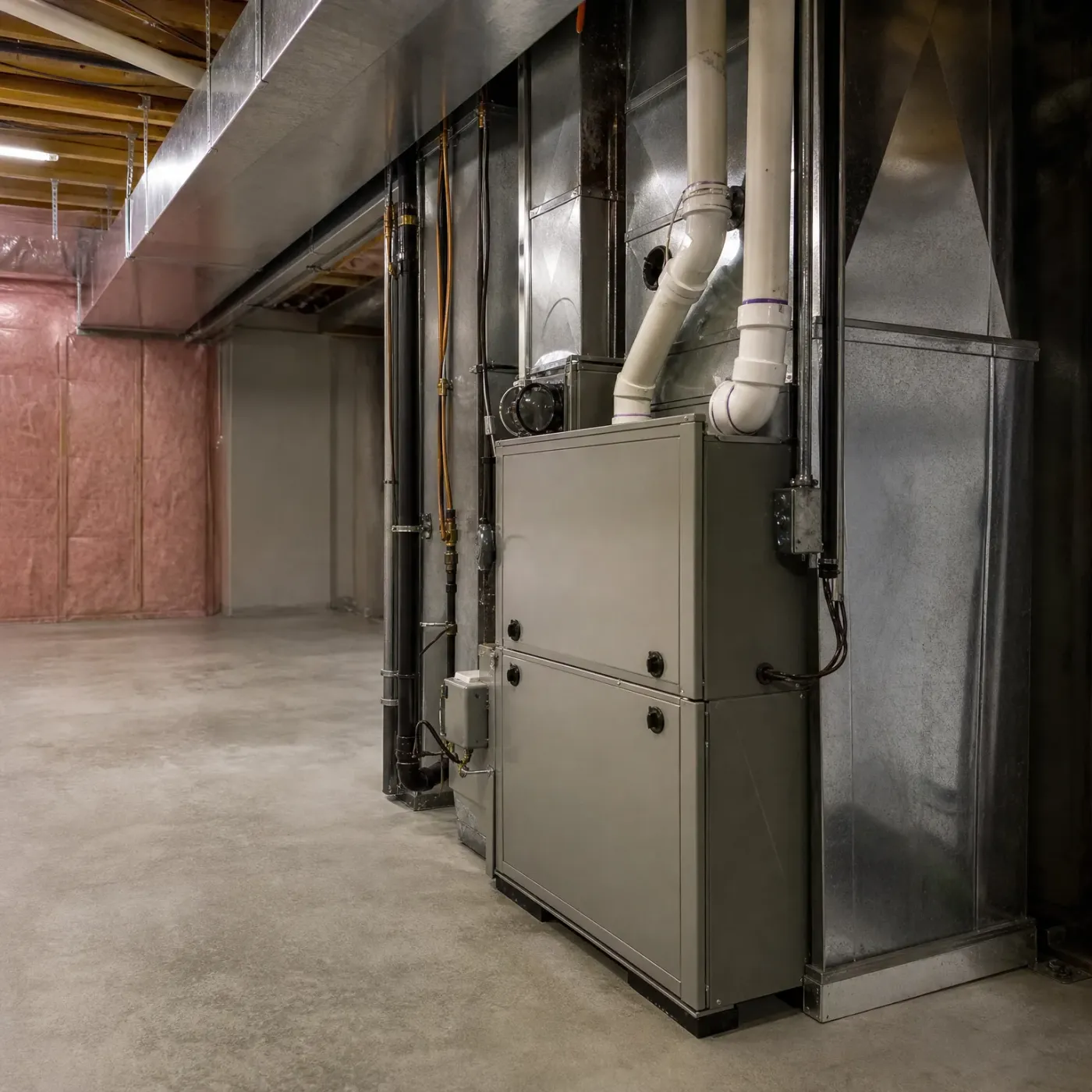
A gray high-efficiency furnace in a basement with white PVC vent pipes, sheet-metal ductwork, copper and black piping, a condensate pump, and insulated walls above a concrete floor.

High-efficiency furnace

If your furnace is a newer high-efficiency model, some water is normal. It cools exhaust gas enough to pull condensate out, and that water drains out through a PVC line, often with a condensate pump nearby. A leak here usually means a clogged line or a pump that's failed.


A beige residential furnace stands on a concrete basement floor beside galvanized sheet-metal ductwork, a round flue pipe, copper gas piping, and a PVC condensate line, with a wood-paneled wall at right.

Older standard furnace

An older furnace with a metal flue shouldn't produce condensate at all, so water around it points somewhere else. It could be a cracked heat exchanger, a nearby humidifier, or a drain line from another appliance sharing that same spot in the basement.

Condensate Leak or Something Else

Condensate problem

  • The drain line or trap is clogged, often with algae or sludge, and water backs up into the cabinet instead of draining outside.
  • A cracked or disconnected PVC line lets condensate drip inside the furnace instead of carrying it away.
  • The condensate pump has failed or its float switch is stuck, so water has nowhere to go but out.
  • Flue pipe sloped the wrong way can trap condensate instead of letting it drain toward the furnace.
  • A clogged line is usually a quick fix once a technician clears it and checks the pump.

Something else going on

  • A furnace without a condensate system that's leaking water likely has a different source, like a nearby humidifier or AC line.
  • If the furnace sits near the air conditioner's indoor coil, a clogged AC drain can show up as water under the furnace in summer.
  • A cracked heat exchanger can let flue gas condense and leak inside the cabinet, which calls for inspection, not a quick patch.
  • Water from outside, like a roof leak or grading problem, can run down a duct or flue and pool near the furnace.
  • Rust on the burner or control board points to a leak that's been going on for a while, not something new.
A gray high-efficiency furnace stands on a concrete basement floor beside galvanized sheet-metal ductwork, white PVC vent pipes, copper and black piping, and unfinished wood stud framing.

Running the way it should

This is a high-efficiency furnace doing normal work. The PVC pipes carry condensate away from the unit, and as long as that line stays clear and sloped right, the water goes where it's supposed to go instead of into the cabinet.

A gray furnace with two access panels stands on a concrete basement floor beside sheet-metal ductwork, with pipes, flexible conduit and an electrical box on the concrete wall to the left.

Water where it shouldn't be

Here the same kind of furnace is in trouble. Water is reaching the cabinet floor instead of the drain line, which points to a clog, a cracked fitting, or a condensate pump that stopped keeping up. A furnace tech in Indiana can trace it to the actual part.

A man with grey hair and stubble in a dark sweater sits on a grey sofa indoors, looking off to the side, with a potted plant and a sunlit window behind him.
A man with gray hair, a beard and glasses, wearing a dark green sweater, sits on a gray sofa in a sunlit living room with a potted plant, table lamp and wooden sideboard behind him.
A middle-aged man with graying hair and a short beard sits on a blue sofa in a living room, looking toward a window, with a bookshelf, lamp and framed picture in the background.
A man with graying curly hair and a dark green sweater sits on a gray sofa in a sunlit living room, looking off to the side, with a framed picture, shelving, an armchair and a window with sheer curtains behind him.
An unfinished basement with a concrete floor, pink insulation on one wall, exposed joists, galvanized sheet-metal ductwork, PVC vent pipes, and a tall gray furnace with attached gas and electrical lines.

Get your furnace to the right pro

Your request stays with one local pro.

Tell a local repair pro what your furnace is doing.

Find a local pro

You only hire the pro if you want to.

A gray high-efficiency furnace with white PVC vent pipes stands beside sheet-metal ductwork and a water heater in an unfinished basement with concrete walls and wood framing.
This high-efficiency furnace vents through PVC pipe instead of a metal flue, and that pipe is doing its job carrying condensate out.
A beige gas furnace with a metal flue pipe stands in a basement against concrete block walls, beside sheet-metal ductwork, copper and white plastic pipes, and a water heater at right.
This older furnace runs on galvanized ductwork with no condensate line at all, so any water here points to a problem, not a byproduct.
  1. Burning gas in a high-efficiency furnace produces water vapor as exhaust

  2. The secondary heat exchanger cools that exhaust until the vapor condenses

  3. Condensate drips down into a drain pan below the heat exchanger

  4. Water flows from the pan through a PVC drain line

What are you noticing around your furnace right now

You might see a puddle on the floor under the cabinet, or water staining the concrete around the base. Sometimes it shows up as rust forming on the burner compartment or the bottom panel. You may hear a gurgle from the drain line when the furnace cycles on, or notice the condensate pump running more than usual. If the water has been sitting a while, there could be a musty smell near the unit. Left alone, water pooling near the cabinet can rust out the heat exchanger or trip the furnace's safety switch, shutting the system down when you need it most, and standing water near electrical connections is its own hazard.

An older beige furnace with two louvered vent panels stands on a concrete basement floor, connected to galvanized ductwork and a metal flue pipe, with gas piping and flexible conduit on the wall behind.
Before you get your furnace repair
A beige high-efficiency furnace in an unfinished basement, with white PVC vent pipes, a yellow gas line, metal ductwork, and exposed wood framing on a concrete floor.
After you get your furnace repair

A furnace with a secondary heat exchanger makes condensate the whole time the burners are firing, and all of that water has to go somewhere. It first passes the condensate trap, which holds a bit of water on purpose to keep exhaust from pushing back up the drain line. That only works if the trap has water in it and sits the way it was installed. From there the water either runs down a sloped PVC line or drops into a pump with a float switch that turns the pump on once the reservoir fills partway. Any one of these can fail quietly. A trap that's dried out, a float switch that's stuck, a drain line with even a slight sag in it, any of these will send water into the cabinet instead of outside. Because condensate keeps forming as long as the furnace runs, a blockage anywhere in that path tends to show up within a cycle or two, not weeks later.

Where the water actually comes from

  • The condensate trap uses a small amount of standing water to block furnace exhaust from escaping through the drain line.
  • If that trap dries out or sits the wrong way, exhaust pressure can push water back up into the cabinet instead of down the drain.
  • A condensate pump, where one is installed, switches on only when water in its reservoir reaches a certain level.
  • If the float switch inside that pump sticks or fails, the pump won't kick on and water backs up instead.
  • The PVC drain line runs with a slight downward slope, and even a small sag in it lets water pool and work back toward the furnace.
  • On furnaces with a secondary heat exchanger, condensate forms continuously while the burners run, so a blocked path shows up fast.
A woman with shoulder-length brown hair wearing a beige knit cardigan sits in a gray upholstered armchair near a window, looking off to the side with a slight smile, with bookshelves blurred in the background.
A woman with her hair in a bun holds a sleeping young child against her chest, both wrapped in a textured beige knit blanket on a sofa in a dimly lit room with a lamp, framed picture, and bookshelf behind them.

A high-efficiency furnace can produce several gallons of condensate on a cold day, all of it meant to leave through that PVC line.

When the line clogs or the trap sits wrong, that same water has nowhere to go but back into the cabinet.

58.6% of homes statewide heat with gas

With gas heating most Indiana homes, chances are good yours is one of them, and a gas furnace that's high-efficiency makes condensate as a normal part of running. That water needs a clear path out through the drain line, so a leak usually means something along that path failed, not the furnace itself.

ACS 2020-2024 5-year B25040

A furnace leaking water almost always comes down to a blocked drain line, a bad trap, or a crack letting condensate go where it shouldn't. Once you know which one it is, fixing it is straightforward work for someone who does it regularly. A local contractor who services furnaces all winter has seen this exact problem many times, often on the same models running in homes near yours, and knows where to look first. You'll be matched with one contractor, not a handful calling you back at once, so you can talk through what you found and get a straight answer about what's happening under your furnace. Until then, keep an eye on the puddle and avoid running the furnace if water is reaching the burner compartment or any electrical parts. The leak has a cause, and that cause has a fix.

Kitchen corner with cream upper cabinets, oak lower cabinets, white marble-look countertop, beige tile backsplash, a ceramic vase of greenery, a wooden cutting board and bowl, and a black-framed window at right.
Interior corner of a room with a white-framed window and wide sill, beige walls with panel molding, a wooden cabinet holding a ceramic vase with a green leafy plant, and blurred shrubs and trees outside.
A wood-framed armchair with beige cushions and a woven lumbar pillow sits in a corner beside a large window overlooking green trees, with a tall ceramic vase holding leafy branches on the left and plaster walls and wood flooring.
Interior corner with a white-framed window above a sill, beige walls with baseboard molding, a greige shaker-style cabinet with brass knobs and a potted plant on top, light wood flooring and a woven jute rug.
A dark-framed six-pane window with white trim and sill set in gray horizontal lap siding, with hydrangea shrubs below and a white column and shingled roof section at left.

The right pro for this job

Your request goes to one pro, not a list of companies.

Get a licensed local pro

Asking costs nothing, and the choice to hire stays yours.