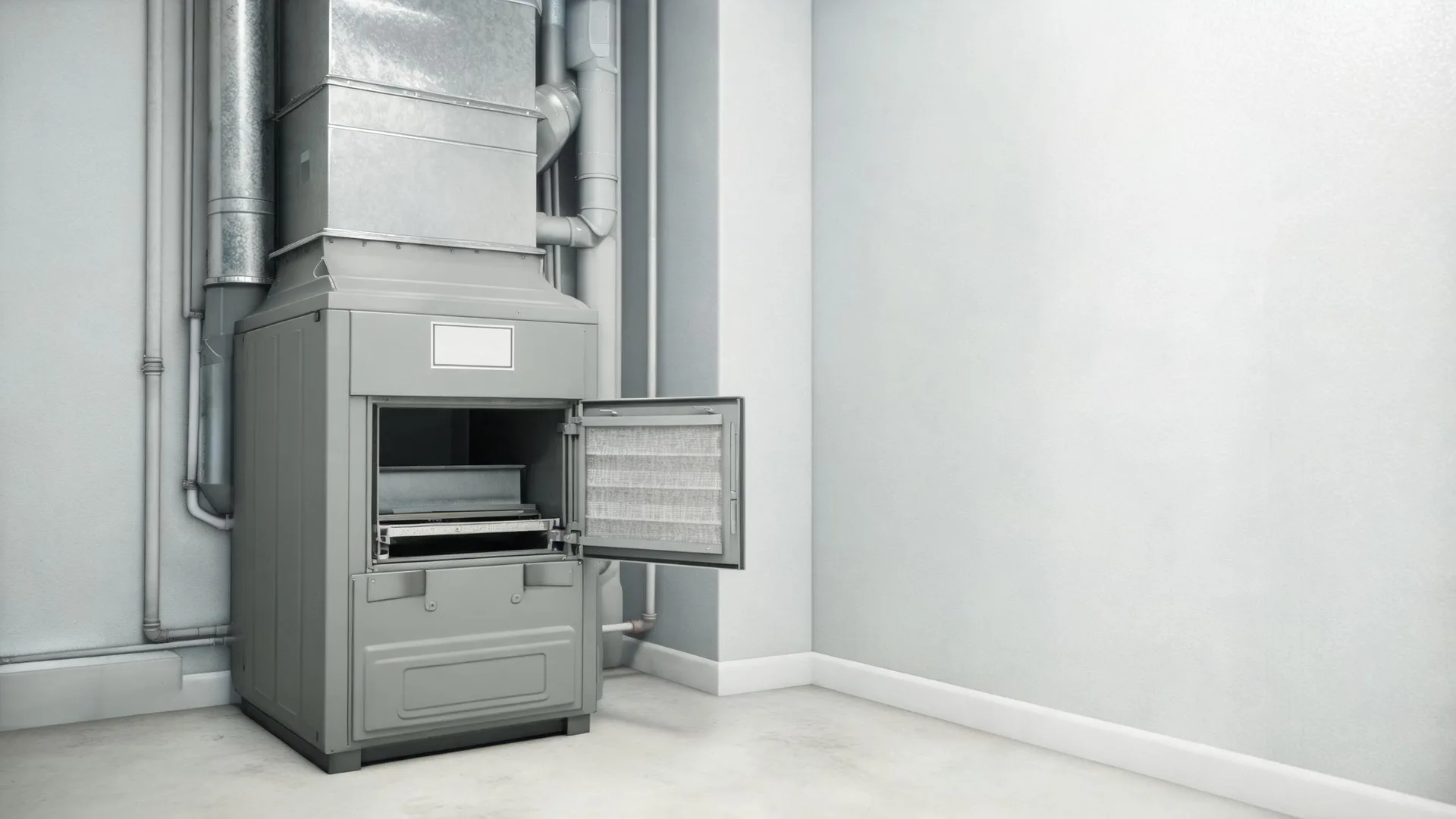
September is the month to book it
Furnaces here start running in October and stay on through April. September gives a technician time to check the igniter, the heat exchanger and the blower before the first cold night asks something of them.
Takes about a minute. No obligation.
Furnaces here start running in October and stay on through April. September gives a technician time to check the igniter, the heat exchanger and the blower before the first cold night asks something of them.
Once the heat goes on in Bartholomew County, it stays on for seven straight months. A furnace that starts the season with a problem carries that problem through most of the year.
Furnace here runs seven months straight, October through April.
One visit a year, before October, covers a furnace for that whole run.

A furnace usually tells you before it quits. The burner flame should burn blue and steady. If it's flickering yellow or orange, that's a sign the gas isn't burning clean. Short cycling, where the furnace fires up and shuts off again before the room warms, often points to a clogged filter or a failing sensor. A burning or musty smell in the first few minutes after startup can mean dust on the heat exchanger, and that one is worth catching early since a cracked heat exchanger is not a small repair. Rooms that used to heat evenly but now run cold in the corners can mean the blower isn't moving air the way it should. None of these mean the furnace is about to fail tonight, but each one is the furnace asking for a look before it asks for a replacement.
It starts running hard in the first month of the season here. Book the check the month before.
Find a contractorThe filter is the one thing worth checking without calling anyone. Pull it out once a month while the furnace is running. If you can't see light through it, swap it. A clogged filter starves the burner of airflow and makes the blower work harder than it was built to, and that shortens its life. Keep vents open and unblocked by furniture or boxes, even in rooms you don't use much, since closing them off raises pressure in the ductwork. Keep the area around the furnace clear too. It needs room to pull in air. Past the filter and the vents, leave it alone. The burner, the igniter and the heat exchanger aren't something to open up yourself, and a panel left off or put back wrong can turn a small issue into a dangerous one.
A draft inducer can spin up fine and still fail to build enough vacuum to satisfy the pressure switch. A technician checks that reading while the furnace is actually trying to fire, not by watching the wheel turn. Catch it in the fall and it's a part swap. Miss it and the furnace just won't start on the first cold morning.
Every time a furnace fires up and shuts down, the metal in its wiring and connectors heats and cools with it. Over a season that cycle works screws and spade connectors loose. A loose connection at the control board or the gas valve can cause a furnace to stop mid-cycle for no reason anyone can see from outside the cabinet. Tightening those down is part of the check, and it's the kind of thing nobody notices until it's already failed.
Skip a year and usually nothing happens right away. A furnace is built to run without attention for a while, and that's what makes it easy to put off. The trouble starts quiet. Dust builds on the igniter until it struggles to catch. The flame sensor fouls with a film nobody can see, and the furnace starts shutting off minutes after it fires. Airflow drops as the blower wheel collects dust, so the house heats unevenly and the system runs longer trying to catch up. None of that trips a breaker or sets off an alarm. The furnace just keeps working, a little worse each week, until the part that was already failing finally gives out.
A real tune-up checks that the furnace is safe to leave running, not just that it turns on. That means measuring gas pressure at the manifold, since too high or too low throws off the whole burn. It means checking the flame sensor's microamp reading instead of just looking at the flame. It means pulling the blower wheel if needed to see the buildup on the blades, not just peering at it with a flashlight. The igniter gets tested under load, since one can glow and still fail the moment it's asked to light the burners. The condensate line gets checked too, on furnaces that have one, because a clogged line backs up and shuts the system down on its own. A technician who skips these isn't saving you time. They're just not looking.