





A row of dark-sided single-story houses among large deciduous trees, with a trimmed hedge in the foreground and a mown lawn crossed by a paved path.

Furnace Repair in Greenfield, IN

Tell us about the job

Takes about a minute. No obligation.

RepairFurnace or heatingHancock County, IN
Step 1 of 2

What ZIP code is the job in?

September is worth a look before heat season starts in October. Furnaces here run about eight months, October through May, and the first real cold snap is when a weak part finally gets tested. A cracked heat exchanger or a worn igniter can sit fine all summer and fail the first week the system has to work. If yours struggled last spring when you shut it off, that same problem is still there waiting for October.

8 months
October through May, your furnace is on duty
23°F
the average winter night it heats against
61%
of homes here heat with gas, so most furnaces here burn gas
11 winter storms
in ten years, the nights a failure hurts most
Isometric grayscale illustration of a cutaway house showing an interior furnace with a tall flue pipe and ductwork running to rooms under a partially lifted roof.
Your furnace works hardest from November through March.

NOAA nClimDiv, 1991–2020 normals

Eight months of heat a year and nights near 23°F in January is a normal load for a furnace to carry.

A furnace struggling with that is most likely dealing with the usual cause, not something unusual about this place.

Half the homes here were built in 1991 or later

Half the homes here were built by 1991
Heat runs October through May
Winter nights average 23°F

A furnace built with a newer house still has most of its working life ahead of it. If yours came with the house, repair is almost always worth it over replacement. A cracked heat exchanger or a failed control board is a repair either way, not a reason to start over. Ask whoever comes out what year the unit was made, not just the house. That tells you more than a guess ever will.

Get it looked at early

Problems tend to show up in the first weeks of the season, when the load hits a part that was already weak.

Find a contractor
A man in a gray T-shirt and tan work pants, seen from behind, carries a worn canvas tool bag up concrete steps toward a blue front door of a house with gray siding and a potted shrub.
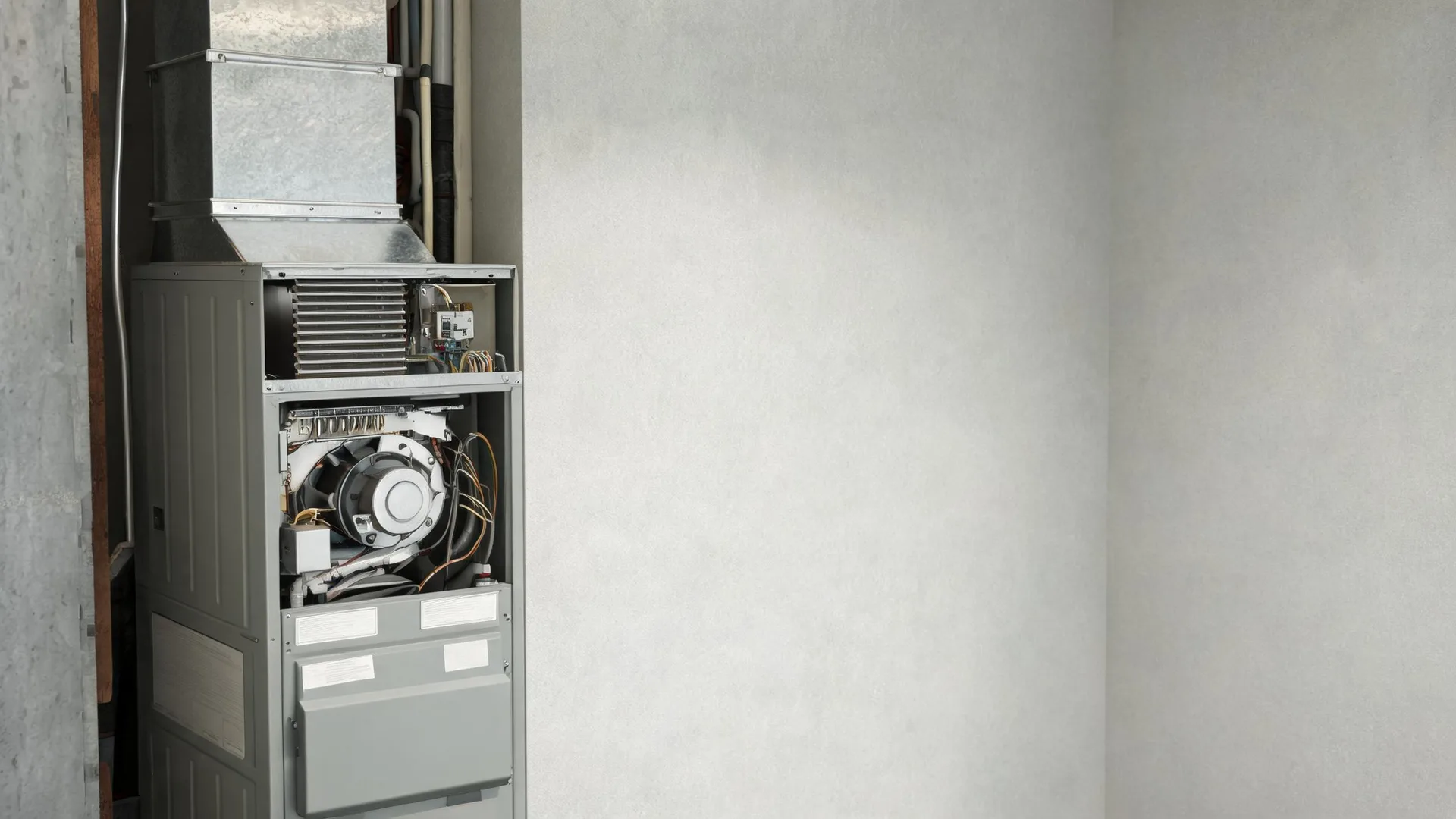
A gray residential gas furnace installed in an unfinished basement, surrounded by ductwork, a metal flue pipe, and a gas supply line.

What to check before you call

Check the thermostat first. Make sure it's set to heat, not cool, and the temperature is set above room temperature. A dead battery in the thermostat stops the whole system before it ever starts. Next, look at the air filter. A filter clogged with dust blocks airflow, and a furnace that can't breathe will overheat and shut itself off as a safety measure. Go to the furnace itself and check that the switch nearby, the one that looks like a light switch, is flipped on. People bump it or mistake it for something else. If you have a gas furnace, check that the gas valve is open and that any switch on the unit's door is in place, since some furnaces won't run if the access panel isn't seated right. Look at the vent pipe outside where it exits the house and make sure nothing is blocking it, no leaves, no snow, no nest. If the furnace runs but the air feels cool, give it a few minutes before judging, since it takes time to warm up. If you smell gas at any point, stop checking and get outside.

A small problem doesn't stay small

A furnace with a weak part doesn't rest when you ignore it. A cracked heat exchanger gets worse every cycle it fires. An igniter that struggles to catch today can quit catching at all next time. Running a struggling system doesn't give it a chance to recover. It just adds more cycles of strain to the same weak point.

The safety shutoffs are doing their job

A furnace that overheats or senses something wrong is built to shut itself down rather than keep going. If yours is cutting off mid-cycle or tripping out, that's not a separate problem to chase down. It's the system protecting itself from whatever is already failing, and it will keep doing it until that cause gets fixed.

An unfinished basement containing a gray HVAC furnace with ductwork, exposed wooden joists, a concrete floor, and miscellaneous clutter in one corner.

A new furnace would cut about $110 a year off heating for a typical Hancock County home.

  • A new high-efficiency furnace$420 a year
  • An older furnace$530 a year

Estimates for a typical Hancock County home, compared with an older unit built to the previous federal minimum, from EIA household energy data, Indiana fuel prices and NOAA climate normals. Your home will differ.

Repair makes sense when one part has failed and the heat exchanger is sound.

Replacement makes sense when the heat exchanger is cracked or the furnace keeps needing parts.

A single failed part doesn't tell you much on its own. A cracked heat exchanger or a dead control board can show up in a furnace with years of good running left in it, and in that case fixing it is the right call. What matters more is whether other parts are starting to act up around the same time. A furnace nearing the end of its working life tends to fail in one spot, get fixed, then fail somewhere else a few months later, since everything in it was installed the same year and has been wearing on the same schedule. That pattern is worth paying attention to. One repair on an otherwise sound furnace is just a repair. A string of them, close together, is the furnace telling you it's done.