





A quiet residential street at dusk lined with illuminated two-story brick houses and mature trees.

Heat Pump Installation in Angola, IN

Tell us about the job

Takes about a minute. No obligation.

New system or replacementHeat PumpSteuben County, IN
Step 1 of 2

What ZIP code is the job in?

Electricity in Steuben County runs 19.06 cents per kilowatt-hour on average. That is higher than most counties in the country pay. A heat pump moves heat instead of burning fuel for it, so every degree of efficiency it has or doesn't have shows up directly on your power bill. With power priced the way it is here, the difference between a unit that runs well and one that struggles adds up faster than it would somewhere with cheaper rates. What you install matters more here than it does in most places.

8 months
October through May, your system heats
3 months
June through August, it cools
19°F
the average winter night it heats against
81°F
the average summer afternoon it cools against
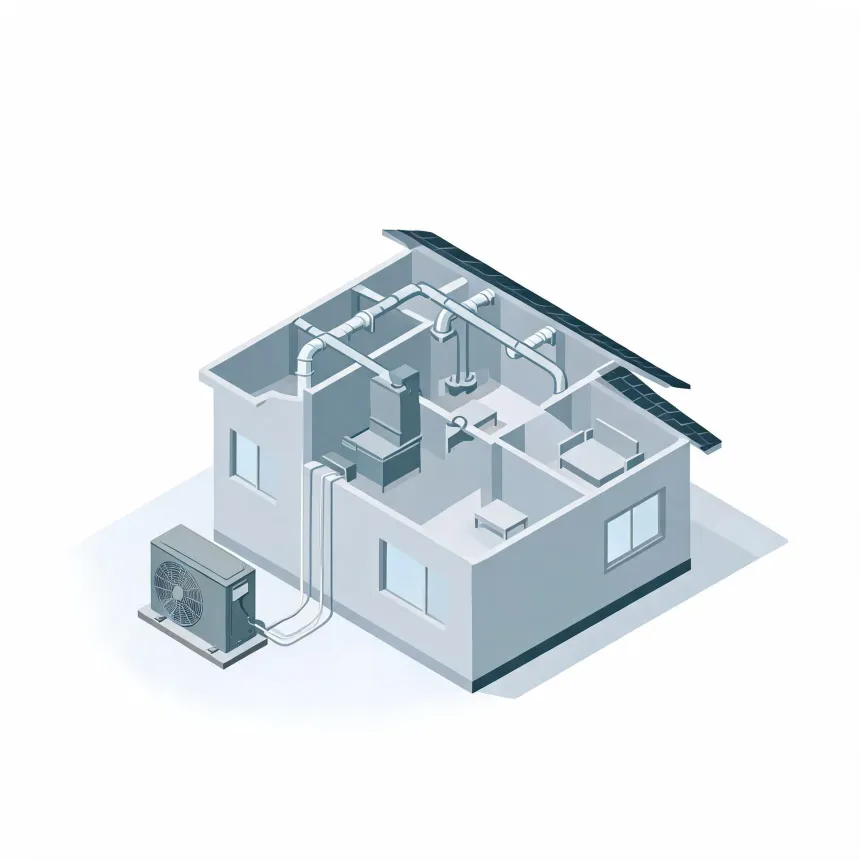
Isometric cutaway illustration of a single-story house showing interior ductwork, an air handler and rooms, with an outdoor condenser unit connected by refrigerant lines on a plain white background.
Your system heats October through May and cools June through August.

NOAA nClimDiv, 1991–2020 normals

Steuben County winters push a heat pump harder than its summers ever do, since the county sits in zone 5A where heating is the bigger job.

A heat pump here isn't fighting extreme heat most of the year, so a solid, reliable unit will hold up without needing the top efficiency tier.

Eight months of heat and three of cooling, on a schedule you pick

Cooling runs June through August
Heat runs October through May
Climate zone 5A

Any split-system heat pump installed here has to clear a federal floor if it was manufactured on or after January 1, 2023: at least 14.3 Btu of cooling for every watt-hour it draws over the summer, and at least 7.5 Btu of heating for every watt-hour it draws over the winter. That floor applies everywhere, not just here. What changes by county is which number matters more. Steuben County sits in zone 5A, where heating is the bigger job, so the winter number is the one doing more work on your bill. A contractor sizing a system for this county is already building from that minimum before any talk of going higher.

Get the installation right, and you collect on it every month

Power here runs high, so the installation is what decides whether you get the efficiency you paid for. Sizing the unit to your home, matching it to your ductwork, setting the charge right once it's in, all of that determines whether the rating on the box shows up on your bill. A heat pump put in carelessly can run well below what it's rated for. Getting it installed right is how you collect on the efficiency you bought.

Find a contractor
A man in a dark long-sleeve shirt and tan pants climbs porch steps toward a blue front door, carrying a worn canvas tool bag with tools in its side pockets, beside a potted shrub in a blue planter.
A gray air-source heat pump mounted on a concrete pad next to a house with gray vinyl siding, surrounded by gravel and flanked by green shrubs and white hydrangea flowers.

The Climate Won't Wear It Out. Weather Still Might.

Wind has hit this county 52 times between 2015 and 2024. Hail came through 26 times, winter storms another 13. None of that is about how hard the unit runs day to day. It's about what hits the outdoor unit sitting there through all of it. A heat pump here spends most of its time working a moderate load, not straining against months of extreme heat or extreme cold. So when one fails early, the cause is more often a storm, age, or a part that got neglected than a machine worn down from overwork. That changes what you're paying for. You don't need the top efficiency tier to survive this climate, because this climate isn't the hard part. A solid unit, sized right and installed right, is what holds up here.

Sizing the unit is the first cost decision

A heat pump too small runs constantly and still falls short on the coldest days. One too large short cycles, shutting off before it finishes a heating or cooling run, which wears the compressor and leaves the air uneven. Getting the size right means a load calculation on the actual house, the windows, the insulation, the layout, not a guess based on the old unit. That calculation shapes which equipment gets quoted at all.

The ductwork decides what the unit can do

A heat pump only performs as well as the air it can move. Ducts that are too narrow, leaky, or poorly laid out choke the system no matter how good the equipment is. Sometimes the install is straightforward. Sometimes it calls for sealing, resizing, or adding a run to a room that never got enough air. That work is part of the job, not an add-on, and it's a big part of what separates one quote from another.

The old system doesn't just get hauled off. Refrigerant has to be recovered from the lines and the outdoor unit before anything gets disconnected, since venting it isn't legal and isn't safe. Once that's done, a contractor disconnects the electrical, caps or removes the line set, and takes down both the outdoor unit and the indoor coil or air handler. If the new system uses the same duct layout, the old equipment is usually the only thing coming out. If it doesn't, some of the connecting hardware comes out with it. None of this is the hard part of the job. It's the part that happens quietly before the new unit goes in.

Utility gas heats 59.5% of homes in Steuben County, more than any other fuel. Electricity comes in behind propane, at 15.0% against 22.2%. A heat pump runs on electricity no matter what the old system burned, so that split doesn't rule it out anywhere. What it does tell you is that most houses here already have ductwork sized for a gas furnace. A heat pump can usually use that same ductwork, which keeps the install simpler than running a system into a house that never had ducts at all. Replacing what's there is the more common job in this county than adding heat to a space that didn't have it.