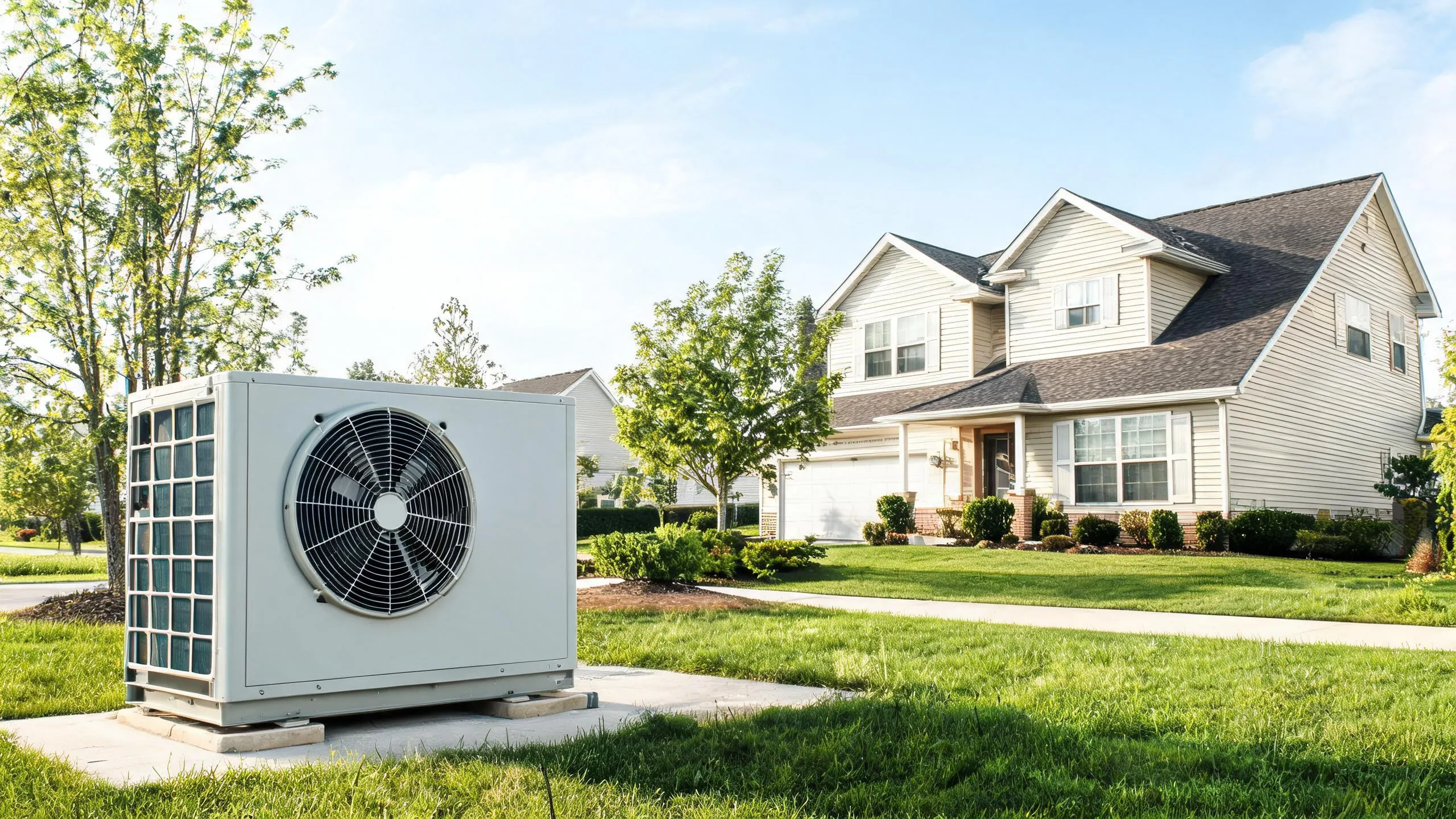






An outdoor heat pump unit mounted on a concrete pad in front of a two-story suburban house with a landscaped lawn.

Heat Pump Installation in Auburn, IN

Tell us about the job

Takes about a minute. No obligation.

New system or replacementHeat PumpDeKalb County, IN
Step 1 of 2

What ZIP code is the job in?

Most houses in DeKalb County heat with gas, better than half of them. Electricity comes in well behind that, under a quarter, and propane covers most of the rest. If your house is one of the gas ones, a heat pump usually gets paired with the furnace rather than replacing it outright. The heat pump handles the mild stretches of the year and the furnace carries the coldest days, so you're not asking one system to do a job it was never sized for. That's the setup a lot of contractors around here will walk you through first, simply because it matches how most homes are already built.

8 months
October through May, your system heats
3 months
June through August, it cools
20°F
the average winter night it heats against
82°F
the average summer afternoon it cools against
Isometric grayscale illustration of a cutaway single-story house showing interior rooms, ductwork and an air handler, an exterior condenser unit connected by lines, and dark solar panels on the roof.
Your system heats October through May and cools June through August.

NOAA nClimDiv, 1991–2020 normals

Auburn's heat pump has one job in the summer: pull a dew point that sits around 61 degrees down to something comfortable.

That's a lighter lift than the muggy South asks for, so the system underneath it doesn't need to be oversized to keep up.

Half these houses were built before anyone sized a heat pump for this climate, and a standard one still does the job

Half the homes here were built by 1975
38 damaging wind events from 2015 to 2024
18 hail events from 2015 to 2024

DeKalb County sits in climate zone 5A, a cool zone where heating is the bigger load. Any split-system heat pump built new has to clear a federal floor before it can go in a house, here or anywhere else: at least 14.3 Btu of heat moved per watt-hour of electricity in the summer, and at least 7.5 Btu per watt-hour in the winter. In a zone like this, that winter number is the one doing the real work, since the heating load is what the system has to be built for. A unit that only cleared the summer bar and skimped on the winter one wouldn't be legal to sell, so whatever a contractor installs here has already cleared both.

A standard heat pump meets DeKalb County's job

A heat pump sized to the federal minimums already clears what winter and summer both ask of it here. Nothing about DeKalb County pushes you toward a bigger unit or a higher-tier one. Pair it with your gas furnace, size it to the house, and it meets the job.

Find a contractor
A man in a cap, dark jacket and tan pants walks up porch steps toward a navy blue front door, carrying a canvas tool bag filled with hand tools, with a potted plant in a blue planter to the right.
A gray heat pump condenser unit mounted on a concrete pad against the gray lap-siding exterior wall of a house.

Eight months of heat, three of cooling, and a narrow window to choose on your own terms

Installed now, a heat pump here spends most of its year on heat, not cooling. October through May it carries the load, eight months out of twelve, with December through February averaging a 20 degree overnight low. June through August it switches over and runs about three months of cooling. September and May are the quiet months in between, before either season asks anything of it, which makes them the better time to put a new system in. Wait until October or June and you're deciding under pressure, with whatever unit is available that week instead of the one that fits your house.

How it's sized to the house

A contractor should run a load calculation on the house itself, room by room, rather than quoting a size based on square footage alone. Ask what goes into that number: the windows, the insulation, the ductwork already in place. A system sized too big will short cycle, run for a few minutes and shut off, which wears on the compressor and leaves the house clammy. One sized too small runs constantly and still can't keep up on the coldest or hottest days.

How it talks to the furnace

When a heat pump is paired with a furnace, something has to decide which one runs and when. Ask how that handoff works and at what outdoor temperature it happens. Some setups use a thermostat that manages both systems together, others wire the switch through an outdoor sensor. Either way, you want a straight answer for how the switchover is set, not just that it exists.

The efficiency rating on the label, the HSPF2 and SEER2 numbers, tells you how much heat the unit moves for the electricity it draws, not how much heat it can put out. A higher rating means it moves more heat per watt, so it costs less to run over a season than a lower-rated unit of the same size. It doesn't mean the house heats up or cools down faster, and it doesn't mean the unit is bigger or stronger. Two heat pumps can be sized identically for the same house and still carry different ratings, with the higher one costing more up front and less to run after that. The rating is also measured under set conditions in a lab, so it won't match what you see on your own utility bill exactly, but it holds up as a fair way to compare one unit against another before you buy.

A heat pump installed here spends most of its working life on a light load, but it still sits outside through real weather. DeKalb County saw damaging wind 38 times between 2015 and 2024, hail 18 times, and winter storms another 10. None of that is about how hard the compressor runs. It's about what the outdoor unit has to survive just sitting there. Since the system underneath doesn't need to be oversized for this climate, the install is where the money matters more than the spec sheet. A unit set on a solid pad, with clearance to shed snow and ice, and mounted the way a contractor would mount it to hold up against wind, outlasts one picked for a rating it will rarely be pushed to prove.