Electricity here runs 19.19 cents a kilowatt-hour
That is higher than what most US counties pay. A heat pump runs on electricity for both heating and cooling, so that rate applies to the system year round, not just in summer.
Takes about a minute. No obligation.
That is higher than what most US counties pay. A heat pump runs on electricity for both heating and cooling, so that rate applies to the system year round, not just in summer.
Two heat pumps can heat and cool the same house and land on different bills, just from how efficiently each one turns electricity into heat or cold air. At this rate per kilowatt-hour, that difference carries more weight than it would somewhere power is cheap.
NOAA nClimDiv, 1991–2020 normals
A heat pump here spends eight months heating and three cooling, with only May and September free of either job.
Install it before June or before October, and it's running on your timeline instead of covering for the one that just quit.



LaPorte County falls under zone 5A in the 2021 energy code, a cool zone where the furnace or heat pump does more work keeping the house warm than it does cooling it. That's not a formality. It sets a floor for what a contractor can install. Any split-system heat pump built from 2023 onward has to pull at least 14.3 Btu of cooling from every watt-hour it uses, and at least 7.5 Btu of heat the same way. Those are federal minimums, not a target to aim for, so every unit on the market here already clears them. A federal tax credit is available on top of that for units that qualify, which narrows the field further toward the systems built to perform at this level.
Power here costs more than most places pay, and a heat pump runs on it for both jobs, heating and cooling. The unit picked now is the one turning that rate into a bill for years of winters and summers ahead. Getting the right one in from the start is worth more here than where electricity is cheap.
Find a contractor
A heat pump outside faces two different things here. One is weather, wind and hail, and LaPorte County gets both: 60 damaging wind events and 32 hail events between 2015 and 2024. The other is runtime, and that's what actually wears a compressor down over the years. Summer humidity here is moderate, with the dew point averaging 62°F through June, July and August, so the unit isn't straining against thick air for months at a stretch. Winter is the longer job, but heating load alone doesn't run a compressor into the ground the way constant hard cooling does. Less strain over its life means a repair is usually worth making rather than a sign to replace the whole system. You don't need the highest efficiency model on the lot. You need one built to hold up, since it's winters, not summers, carrying most of the work here.
A heat pump that's too big short cycles, kicking on and off before it ever evens out the temperature or pulls moisture from the air. One that's too small runs flat out and leans on backup heat strips to cover the gap. Getting the size right takes a load calculation on the actual house, room by room, not a guess based on square footage or whatever the old system was rated for. That calculation drives the cost of the unit itself more than any other single decision.
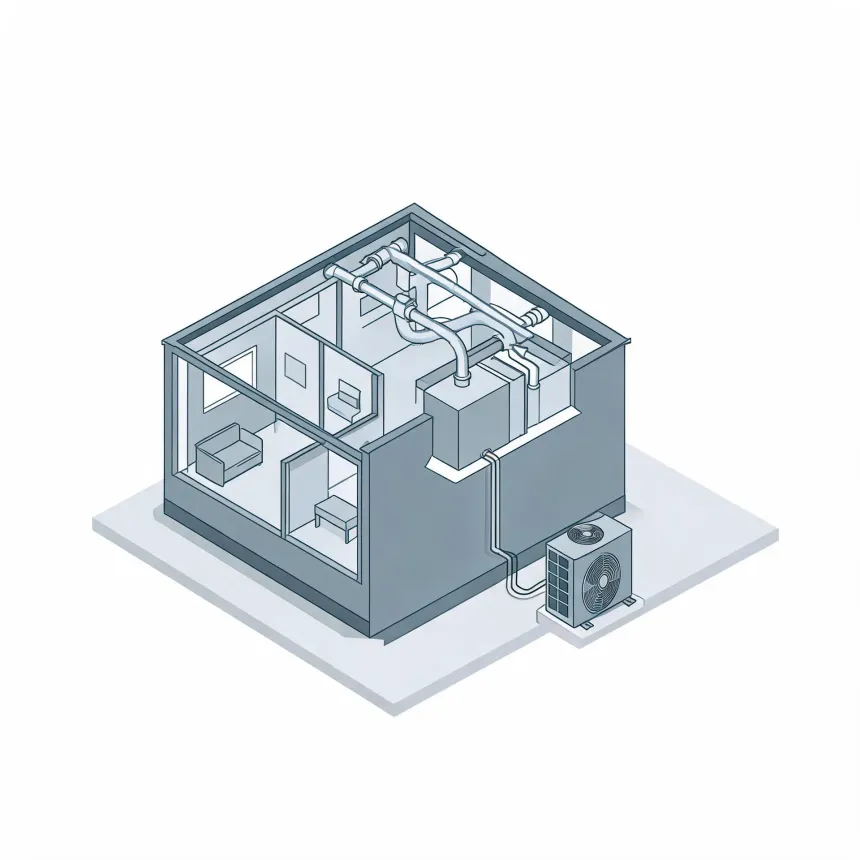
The unit is only as good as the refrigerant lines, the electrical circuit, and the ductwork it ties into. Line sets have to be sized and sealed correctly or the system loses charge over time. The air handler needs the right airflow across the coil, which sometimes means modifying existing ductwork rather than just connecting to it. Skipping or rushing that work costs nothing today and shows up later as a system that never quite performs the way the rating sticker says it should.
The old system doesn't just get unplugged and hauled off. Refrigerant has to be recovered from the lines before anything is disconnected, since it's against the law to vent it into the air, and a tech will need to pull what's left in the coils and the outdoor unit into a tank. Once that's done the old line set usually comes out rather than getting reused, because it's sized for the old equipment's charge and often has years of wear at the joints. If the new system uses a different refrigerant than the old one, which is common when replacing an older heat pump, reusing anything that touched the old refrigerant risks contaminating the new charge. The electrical disconnect and any dedicated circuit get checked too, since the new unit may draw differently than the one it's replacing. None of this shows up on the equipment sticker, but skipping it is how a new system ends up with an old problem.
Most homes in LaPorte County heat with gas, 83.2 percent of them. That's why a lot of heat pumps here get paired with a gas furnace instead of running alone, with the heat pump handling the mild months and the furnace taking over when it gets cold enough that gas is the better deal. A heat pump can still do the whole job by itself, backup strips and all, but a house already set up for gas has a furnace, ductwork and gas line sitting there ready to use. That changes what the install actually involves. It's worth telling the contractor upfront whether you want to keep the gas furnace in the mix or replace it outright, since that decision shapes the whole job, not just the equipment picked.