




Three lit brick homes on a tree-lined residential street photographed at dusk.

Heat Pump Installation in Richmond, IN

Tell us about the job

Takes about a minute. No obligation.

New system or replacementHeat PumpWayne County, IN
Step 1 of 2

What ZIP code is the job in?

Electricity in Indiana ran 14.77 cents per kilowatthour in 2024. A heat pump runs on electricity for every degree of heat it moves, so that rate applies all year, every hour it runs. The efficiency of the unit you install is what stands between you and that rate. A higher-efficiency model moves more heat per kilowatthour, and that difference matters more here than in a state with cheaper power. Ask your contractor which models cost less to run at Indiana's rates, not just which ones cost less to buy.

8 months
October through May, your system heats
3 months
June through August, it cools
22°F
the average winter night it heats against
83°F
the average summer afternoon it cools against
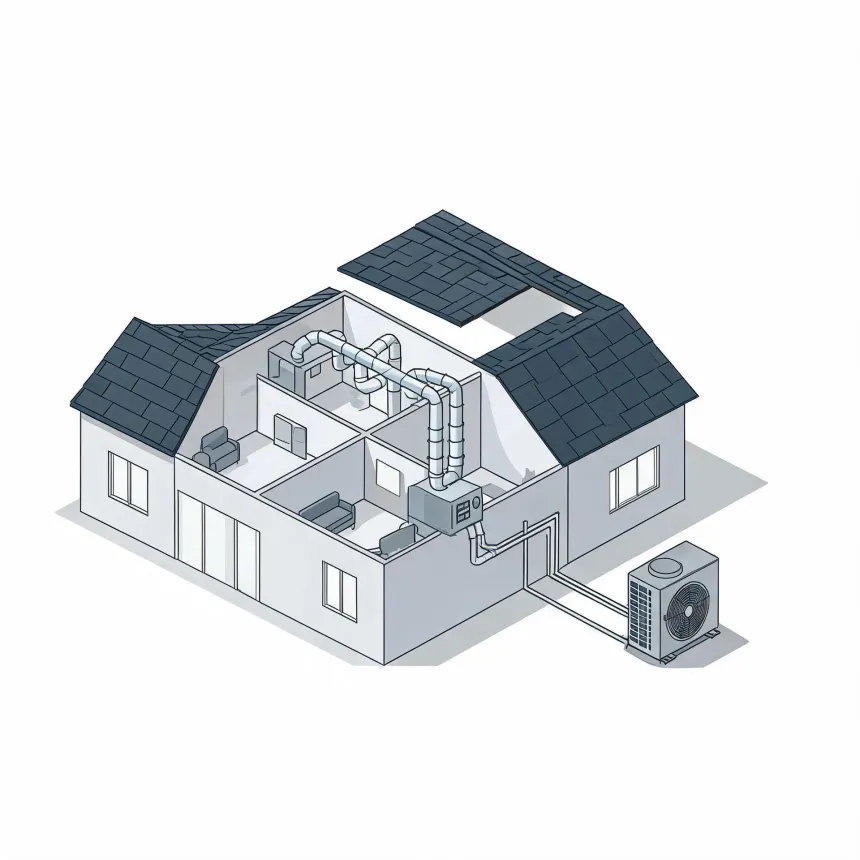
Isometric line illustration of a cutaway single-story house showing interior rooms, ceiling ductwork connected to an indoor air handler, and refrigerant lines running to an outdoor condenser unit on a pad.
Your system heats October through May and cools June through August.

NOAA nClimDiv, 1991–2020 normals

The efficiency rating on the label comes from a lab test, not from the weather outside your house.

Use it to compare models against each other, not to predict what your power bill will do once it gets cold.

October is when heat starts here, so install before then and it's done on your schedule

Cooling runs June through August
Heat runs October through May
68 damaging wind events from 2015 to 2024

Most homes in Wayne County heat with utility gas, and a heat pump is a different kind of system to install and live with. Over half the county runs gas furnaces. About three in ten homes already run on electricity, so a heat pump isn't a strange fit here, but if you're switching from gas you're also changing how your home gets heated, not just the equipment that does it. Gas heat produces hot air at a high temperature and cycles off. A heat pump runs longer, moving heat at a lower temperature the whole time. Ask your contractor how that changes what you'll feel from the vents on the coldest days, and whether the ductwork sized for a gas furnace will move enough air for a heat pump.

In zone 5A, the minimum is 14.3 SEER2 and 7.5 HSPF2

Wayne County falls under zone 5A, a cool zone where heating is the bigger job. Any split-system heat pump made from 2023 on has to clear 14.3 SEER2 for cooling and 7.5 HSPF2 for heating to be sold here at all. That floor narrows what a contractor can install. A federal tax credit is available on top of that for qualifying equipment, worth asking about when you compare models.

Find a contractor
A gray heat pump outdoor unit mounted on a concrete pad next to the stone-accented exterior wall of a house.

Your house was likely built for a different kind of heat

Half the homes in Wayne County were built in 1960 or earlier. A house that age has likely had its heating system replaced at least once already, and whatever ductwork is in place now was sized for whatever ran before. A heat pump moves air differently than a gas furnace does, running longer at a lower temperature instead of short bursts of hot air. Ask your contractor to check the ductwork before settling on equipment, not after. What fits your house depends on what's already there, not just how many square feet you're heating.

Your contractor hauls it away

Pulling the old furnace, coil or condenser is part of a normal install, not a separate job. The contractor disconnects the refrigerant lines, caps or repurposes the gas line if you're switching away from gas, and removes the indoor and outdoor units. None of that gets left behind for you to deal with.

Refrigerant has to be recovered, not vented

The refrigerant in the old outdoor unit can't just be released into the air. A licensed contractor recovers it into a tank with certified equipment before the unit comes apart. That's a legal requirement, so it's worth confirming it's part of the job rather than assuming it.

Sizing a heat pump isn't about matching tonnage to square footage. A contractor works out how much heat your house loses on the coldest day of the year and how much it gains on the hottest, room by room, based on your windows, your insulation, your walls. That's called a load calculation, and it's the only honest way to size the equipment. Too big and the unit short-cycles, reaching the thermostat's setpoint fast and shutting off before it's run long enough to pull humidity out of the air or warm the house evenly. Too small and it runs flat out on the coldest and hottest days and still falls behind. Either mistake is one you live with for as long as the equipment is in the house, so the sizing has to happen before anything gets bought, not after.

Install day starts with the crew showing up with both units, the line set, and whatever ductwork changes were agreed on ahead of time. The outdoor unit comes out first, then the indoor coil and air handler or furnace pairing, depending on what you're running. Setting the new outdoor unit means a level pad and enough clearance around it for air to move freely, since a heat pump pulls air through that unit even in the coldest weather. Running new line set or reusing the old lines depends on their condition, and a contractor checks that before assuming the old copper is fine. Once everything is connected, the system gets charged with refrigerant to the exact weight the manufacturer specifies, not just topped off until it seems to cool. Then it runs through a startup check, checking airflow, checking the charge, checking that the thermostat is actually talking to the equipment, before anyone calls it done.