






A nighttime view of a tree-lined residential street with illuminated two-story brick houses and street lamps.

Heat Pump Repair in Anderson, IN

Tell us about the job

Takes about a minute. No obligation.

RepairHeat PumpMadison County, IN
Step 1 of 2

What ZIP code is the job in?

October is when most heat pumps in Madison County get tested for the first time in months. The switch from cooling to heat puts new strain on parts that may have been struggling all summer without you knowing it. A weak capacitor or a failing reversing valve often makes it through August just fine, then quits the first cold week of fall. If your heat pump is blowing cool air or won't switch over to heat at all, that's usually what's going on. Getting it looked at early in the season means you're not stuck without heat once the temperature really drops.

8 months
October through May, your system heats
3 months
June through August, it cools
22°F
the average winter night it heats against
83°F
the average summer afternoon it cools against
Isometric line illustration of a cutaway house showing interior rooms with furniture, ceiling ductwork, and an outdoor condenser unit connected by lines along the exterior wall.
Your system heats October through May and cools June through August.

NOAA nClimDiv, 1991–2020 normals

Winter lows in Madison County average 22°F, not the deep freezes colder regions get.

A heat pump here runs against steadier demands, so a maintained unit usually still has good parts worth repairing.

Madison County doesn't put extra strain on a heat pump. A broken one just needs the right fix.

121 severe weather events from 2015 to 2024
17% of homes statewide lost power a day or more in 2024
68 damaging wind events from 2015 to 2024
A struggling heat pump costs you more hereIndiana power ran 14.77 cents a kilowatt-hour in 2024

Half the homes in Madison County were built in 1965 or earlier. If your heat pump came with a house that old, it's probably not the original unit, but nobody may have told you how old the one in the yard actually is. An older heat pump can still be repaired. The question is whether it's worth it. A failing compressor or reversing valve is a different call on a unit near the end of its life than on one that still has years in it. Before you pay for a big repair, ask the contractor how much life the unit likely has left.

A heat pump here is usually worth fixing

A unit that's been running fine against steady demands for years doesn't usually fail outright. More often it's one part worth replacing. Get the actual cause checked before you assume the whole system is done.

Find a contractor
A gray outdoor HVAC unit mounted on a concrete pad beside a house with gray lap siding and a stone foundation.

The signs show up before the failure does

A heat pump doesn't fail all at once. It tells you first. Short cycling is one of the earliest signs, the unit kicking on, running a few minutes, then shutting off before it's actually satisfied the thermostat. Those hard starts wear the compressor faster than steady running ever does. Listen for it too. A click when it should start, a hum with no fan movement, a new rattle from the outdoor unit. These usually mean a capacitor or contactor is going, and those are small parts to replace next to what happens if they take the compressor with them. Ice on the coil beyond a normal frost, warm air when it should be hot, a unit that runs constantly and still doesn't keep up. Each one is the same message. Something inside is struggling to do what it used to do without effort.

Check the thermostat first

Make sure it's set to heat, not cool, and set a few degrees above room temperature. Some thermostats have an emergency heat setting separate from normal heat. If the system runs on emergency heat but not regular heat, that points straight to the heat pump itself rather than the thermostat.
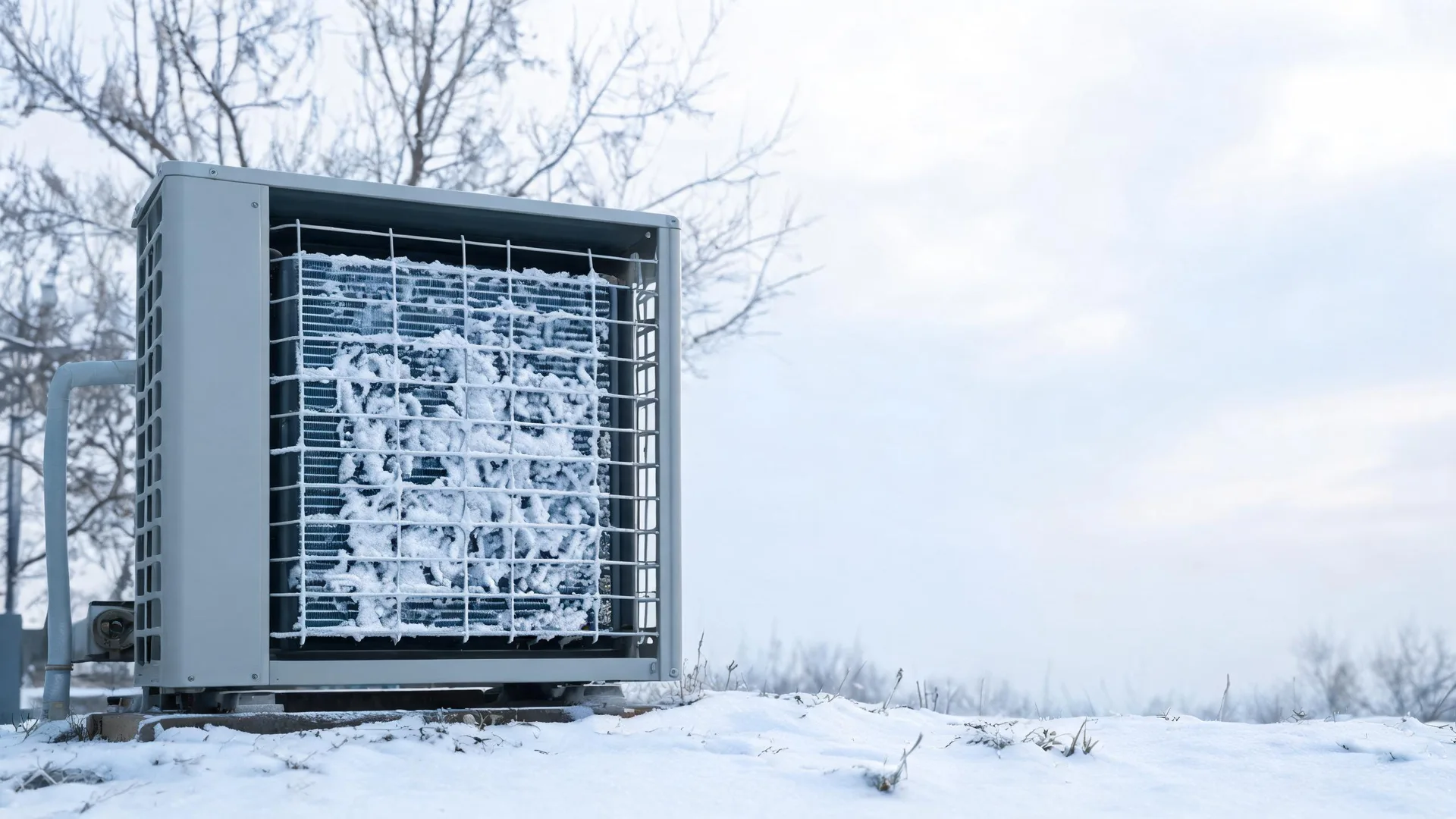
Look at the outdoor unit

Walk outside and check that the fan is spinning and nothing is blocking the coil, no leaves, no ice buildup, no fence or bush grown in too close. A heat pump needs airflow through that coil to move heat. If it's caked in ice beyond a thin frost layer, or the fan isn't turning at all, that's worth telling the contractor before they arrive.

A heat pump low on refrigerant doesn't shut itself off. It keeps running, just worse, and the compressor has to work harder to move the same heat. That extra work means it runs hotter for longer than it should, and heat breaks down the oil meant to protect it. A coil losing airflow to ice or debris causes the same kind of strain, just from a different direction. None of this means the unit is headed for failure. It usually means one part, the compressor or the reversing valve, is taking on damage it didn't need to. A slow leak caught early is a small repair. Left alone through a cold stretch, it can turn into a bigger one.

A diagnostic visit starts outside, at the unit itself. The contractor checks the data plate, then runs the system and watches what it actually does, not just what the thermostat says it should do. Gauges go on to check refrigerant pressure, since that number says more about what's wrong than how the unit sounds or looks. They'll check amp draw on the compressor and fan motor, because a motor pulling more current than it should is a motor on its way out. Inside, they check the air handler, the coil, and airflow through the ducts, since a heat pump starved of airflow fails for reasons that have nothing to do with the refrigerant side. By the time they're done, they're not guessing which part is bad. They know, and they can tell you whether it's worth fixing or worth replacing.