An outdoor HVAC condensing unit on a concrete pad next to a beige single-story house with a dark shingle roof.

Heat Pump Repair in Angola, IN

Tell us about the job

Takes about a minute. No obligation.

RepairHeat PumpSteuben County, IN
Step 1 of 2

What ZIP code is the job in?

September is when a weak heat pump shows it

Heat in Angola starts running in October, and a heat pump that was already struggling tends to fail in the first cold weeks rather than mid-winter. If yours short cycles or blows cool air now, that is the time to get it looked at, before it is working against real cold.


This machine works eight months straight

From October through May, a heat pump here is the only thing keeping the house warm, then it switches over and cools the house in summer too. That long a run gives a bad capacitor or a low charge plenty of chances to show up, so a repair now has to find the actual cause, not just quiet the symptom.

8 months
October through May, your system heats
3 months
June through August, it cools
19°F
the average winter night it heats against
81°F
the average summer afternoon it cools against
Isometric line illustration of a cutaway house showing interior rooms with furniture, ceiling ductwork under a dark shingled roof, and an outdoor condenser unit connected by lines on the right.
Your system heats October through May and cools June through August.

NOAA nClimDiv, 1991–2020 normals

Steuben County sees wind and hail often enough, 52 damaging wind events and 26 hail events in the last ten years, but neither one wears on a heat pump the way its daily run time does.

So when this unit fails, the long season explains it better than the storms it sat through, and that usual wear is worth fixing.

Electricity here runs 14.77 cents a kilowatt-hourA heat pump running on a bad capacitor or low charge burns through that every month it's not fixed.

So when a contractor comes out to look at a heat pump here, the fix is usually a known one. A low charge, a failing capacitor, a dirty coil, the kind of thing that shows up after years of normal running, not after a system fought through hail or a windstorm. That makes the diagnosis more straightforward. The tech isn't guessing whether the outdoor unit took a hit it never recovered from. They're checking the parts that wear out on a schedule, and fixing or replacing the one that quit.

A heat pump that's running bad costs you every month it stays that way

A bad capacitor or a low charge doesn't get better on its own. It just keeps pulling power at 14.77 cents a kilowatt-hour while it struggles. Get it looked at.

Find a contractor
A man in a dark cap, dark shirt and tan work pants walks up wooden steps toward a blue front door, carrying a worn canvas tool bag in his right hand, with a potted shrub beside the entry.
A gray heat pump condenser unit mounted on a concrete pad against the gray lap-siding exterior wall of a house.

What to check before you pick up the phone

Start outside. If the outdoor unit is buried in leaves or crusted in ice that isn't clearing on its own during a normal defrost cycle, that's worth clearing before anyone shows up. Inside, check the thermostat is actually calling for heat and not just powered on. Pull the filter and look at it. If it's gray and matted, swap it. Walk the house and feel the vents. If some rooms get warm air and others don't, don't go chasing that yourself, just tell the tech when they arrive. Pay attention to any new sound, a hard clunk on startup, a hiss, a rattle that comes and goes. None of this tells you what's broken. It gives the tech a place to start instead of checking every part cold.

The signs are usually right there in how it blows

Air coming from the vents that feels barely warm, a unit that runs long stretches without ever satisfying the thermostat, or one that shuts off and restarts every few minutes instead of running a normal cycle. Any of these points to a system working harder than it should to do the same job.

Sound and ice tell you something too

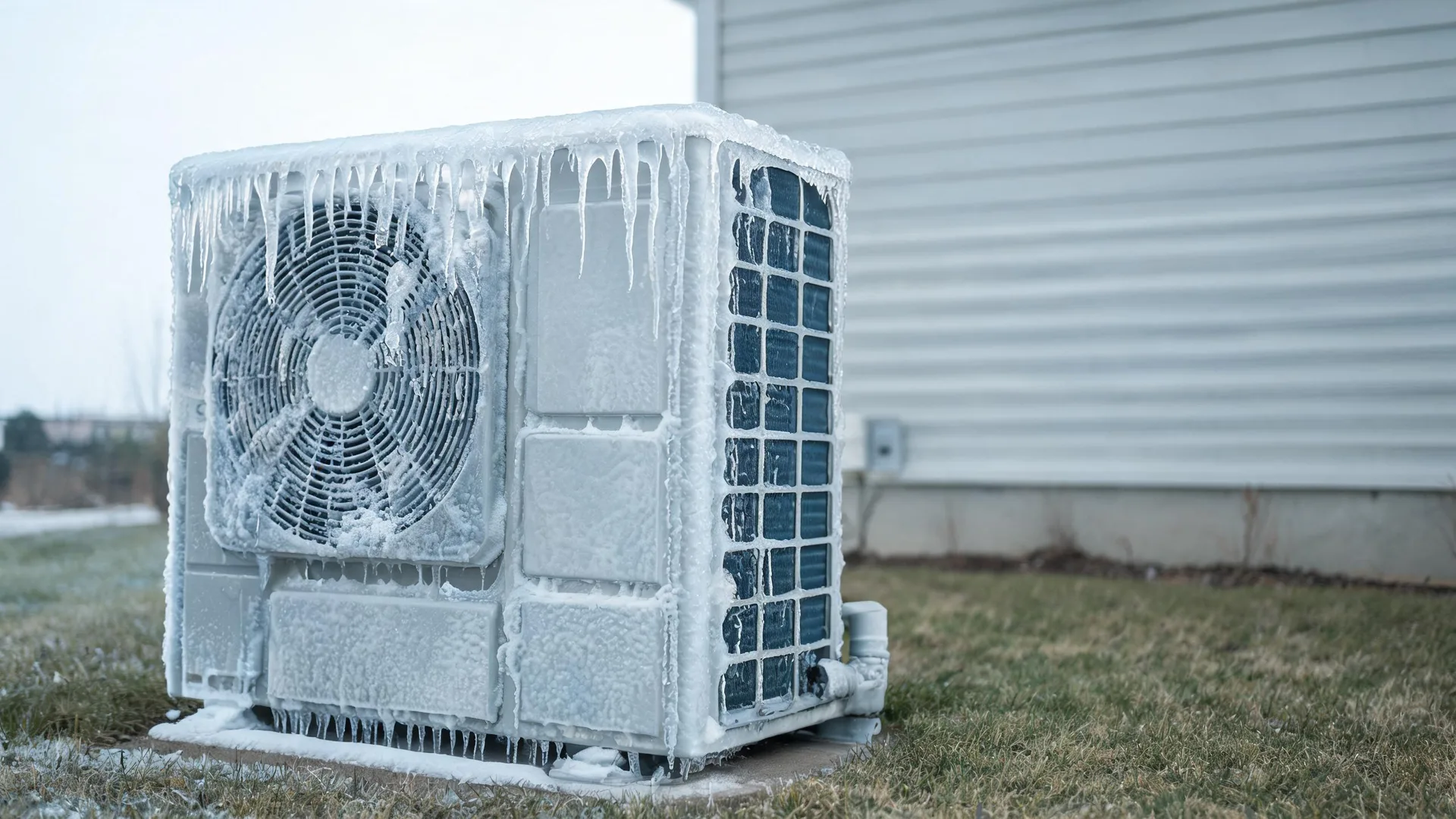
A heat pump that clunks on startup, hisses, or rattles at certain points in its cycle is telling you a part is wearing out before it fails completely. Frost or ice building up on the outdoor unit that doesn't clear during a normal defrost cycle means that cycle isn't working right, and the system will keep losing ground until it's checked.

A lot of heat pump failures come down to a handful of parts that wear out on a schedule. The capacitor is the common one. It gives the compressor and fan motors the jolt they need to start, and it weakens slowly until one day it can't do the job, so the outdoor unit hums but doesn't start, or the fan spins slow. Refrigerant charge is another. A heat pump doesn't use up refrigerant, so a low charge almost always means a slow leak somewhere in the line set or coil, and it only gets worse from there. The reversing valve is what lets the system switch between heating and cooling, and when it sticks, the system keeps running but stops doing what the thermostat is asking for. Coils get dirty over years of normal operation, and a coil caked with dust or grime can't move heat the way it should, so the whole system works harder to get less done. None of these fail because of one bad day. They fail because they've been running toward it the whole time.

At some point the question isn't what's wrong, it's whether fixing it makes sense. Age matters more than any single part failing. A heat pump that's otherwise sound is worth repairing even if the fix is a real one, a reversing valve or a coil, because the rest of the system still has years in it. One that's already had a few different parts go, in different years, is telling you something else. Compressors are the one part that usually isn't worth replacing on its own. A compressor failure on an older system is often the point where a tech will tell you straight that putting money into it doesn't make sense, not because the repair can't be done, but because everything around it is the same age and headed the same way.