A row of dark-painted single-story houses with gray shingled roofs behind a tall trimmed hedge, with mown lawn, a walkway, and leafy trees under an overcast sky.

Heat Pump Repair in Columbia City, IN

Tell us about the job

Takes about a minute. No obligation.

RepairHeat PumpWhitley County, IN
Step 1 of 2

What ZIP code is the job in?

Check the thermostat and the breaker first

Make sure the thermostat is set to heat or cool and the temperature is actually past the point where the system should turn on. Then check the breaker panel for the heat pump and the outdoor unit's disconnect box. A tripped breaker is safe to reset once. If it trips again, stop and leave it alone.


Look at the outdoor unit before you call

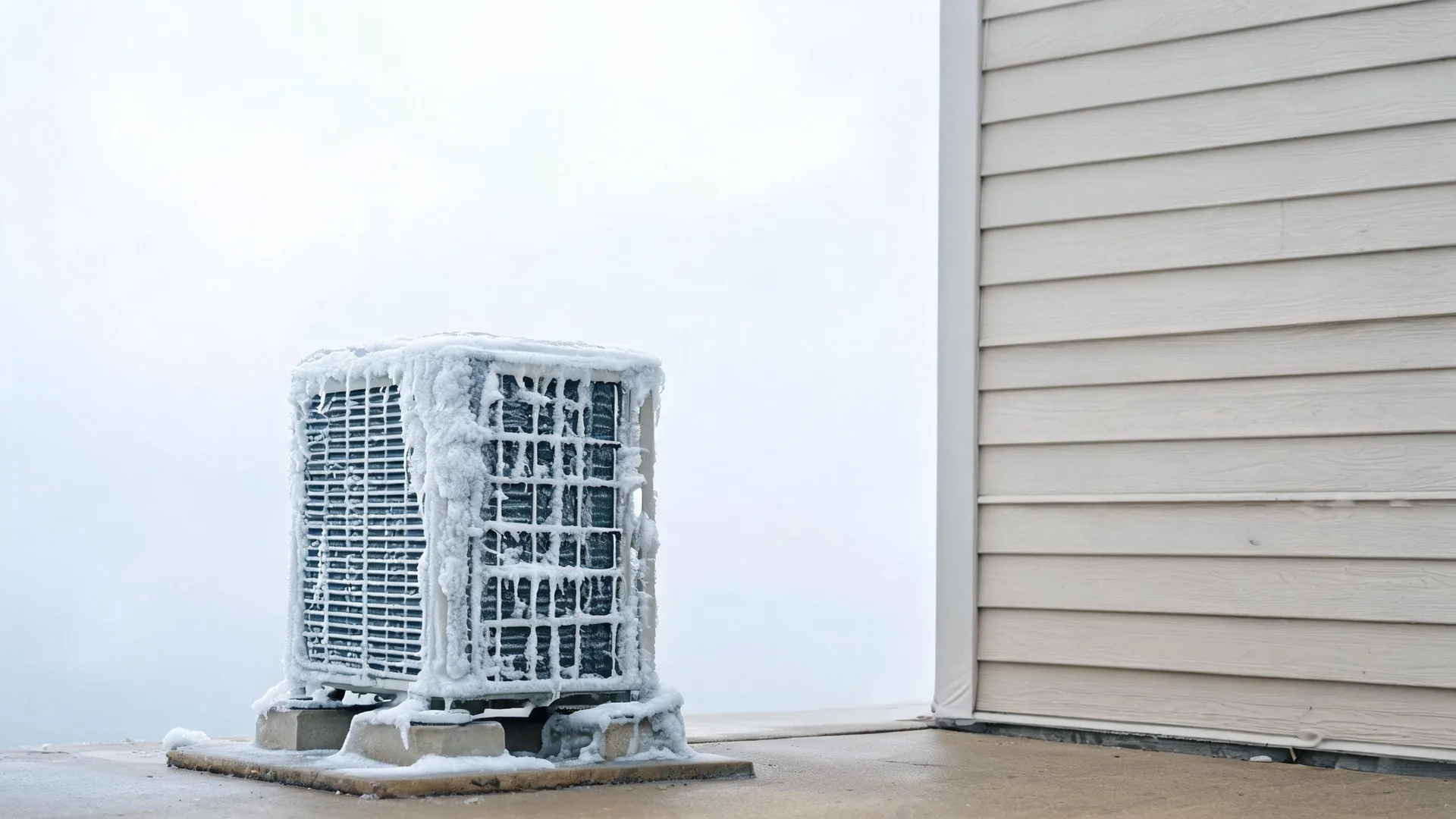
Walk outside and look at the condenser. Clear away leaves, mulch or anything stacked against it, and check that the fan on top isn't iced over or jammed. If the coil is caked in ice outside of a normal defrost cycle, that tells the contractor something specific about where the problem likely is.

8 months
October through May, your system heats
3 months
June through August, it cools
20°F
the average winter night it heats against
82°F
the average summer afternoon it cools against
Isometric illustration of a cutaway single-story house showing interior ductwork and vents connected to an outdoor condenser unit beside the building, on a white background.
Your system heats October through May and cools June through August.

NOAA nClimDiv, 1991–2020 normals

Whitley County winters hold around 20°F overnight, not deep sub-zero, so your heat pump isn't working against the extremes units in colder zones face.

A heat pump with a lighter load behind it is more often a good repair candidate than a replacement one.

At 14.77 cents a kilowatt-hour, a struggling heat pump wastes money every day you wait

Power costs 14.77 cents a kWh statewide
64 damaging wind events from 2015 to 2024
10 winter storms from 2015 to 2024

September is worth paying attention to. That's the month before heat kicks in here, and it's a good time to catch a heat pump that's been limping along. A unit with a weak capacitor or a failing defrost control often makes it through a mild stretch without showing much, then struggles the first cold morning it has to run long and hard. Heat here runs October through May, eight months, so a problem that shows up in week one isn't going away on its own. Getting it looked at before the first real cold snap means a smaller fix now instead of a no-heat call later.

A newer home usually means a heat pump worth fixing

Half the homes in Whitley County were built in 1979 or later, and if yours is one of them, the heat pump likely has years of work left in it. A repair now is usually the right call for a system that age, not a sign it's done.

Find a contractor
A man in a cap, dark long-sleeve shirt, tan work pants and boots walks up wooden porch steps toward a teal front door, carrying a canvas tool bag with hand tools.
A gray heat pump outdoor unit mounted on a concrete pad next to the stone-accented exterior wall of a house.

A lighter load all winter, which favors a repair

That 20°F average overnight low means the outdoor unit isn't cycling on and off against hard extremes the way units in colder zones do. Over a full day it just runs steadier, warming air that's already not that far below room temperature. That steadier pace is easier on the compressor and the moving parts than the start-stop strain of deep cold. If this unit is acting up now, the mild load it's been under all winter is a point in favor of fixing it rather than replacing it. A contractor can usually tell during one visit whether what's wrong is a worn part or something that needs replacing outright.

A failing part doesn't fail evenly

A compressor working against a low charge or a weak capacitor draws harder than it should every time it starts. It still makes heat, so it's easy to let it run. But each start stresses the same winding and the same contacts a little more, and a compressor that's been pushed too long is the one part a contractor can't just repair.

The reversing valve can stick worse if you wait

A heat pump that's slow to switch between heat and defrost is often a reversing valve starting to stick. Left alone, it can hang up fully, either trapping the system in defrost or keeping it from defrosting at all. A unit that won't defrost will ice the outdoor coil solid and stop moving heat completely.

A lot of heat pump failures start with the defrost cycle. The system is supposed to sense frost building on the outdoor coil, switch briefly into cooling to melt it off, then switch back. If the defrost sensor or the control board reading it goes bad, that handoff stops happening right. The coil ices over, airflow drops, and the system works harder for less heat. Dirty filters and blocked return vents push the same direction, since the whole system leans on steady airflow to move heat where it needs to go. Outdoors, a dirty or bent coil loses ground for a simpler reason. Less surface contact with the air means less heat pulled in. None of these start as a no-heat emergency. They start as the system running longer than it used to for the same result.

A diagnostic visit starts outside at the condenser, with gauges on the refrigerant lines and a look at how the fan and compressor are actually behaving, not just whether they turn on. Indoors, a contractor checks static pressure and temperature split across the air handler, since a heat pump can run and still not be moving enough heat to matter. The control board gets pulled and read, because most boards log fault codes even when the system seems to be behaving on the thermostat. Capacitor readings and amp draw on the compressor come next, since a motor can start every time and still be pulling harder than it should. The reversing valve gets tested directly, not just watched, since a valve that's starting to stick doesn't always show it on a single cycle. By the end of the visit the contractor usually knows which part is failing and whether it's safe to run the system until that part comes in.