





A row of dark-sided cottages with brown shingled roofs behind a trimmed hedge, beside a mown lawn and large leafy trees under an overcast sky.

Heat Pump Repair in Columbus, IN

Tell us about the job

Takes about a minute. No obligation.

RepairHeat PumpBartholomew County, IN
Step 1 of 2

What ZIP code is the job in?

Zone 4A means Bartholomew County asks real work of a heat pump in both directions, enough cold in winter and enough heat and humidity in summer that the system earns its keep rather than coasting. That's still a different load than a heat pump faces in a harsher climate, and it shows up in how a unit ages. A system here that breaks down is more often dealing with a worn part or a few years of skipped maintenance than a motor that got run into the ground. That's worth knowing before you decide whether a repair makes sense. Wind and winter storms come through often enough to cause real damage, ten winter storms and forty damaging wind events over the last ten years, so if something's off after a rough night, the weather is a reasonable first suspect.

7 months
October through April, your system heats
4 months
June through September, it cools
24°F
the average winter night it heats against
84°F
the average summer afternoon it cools against
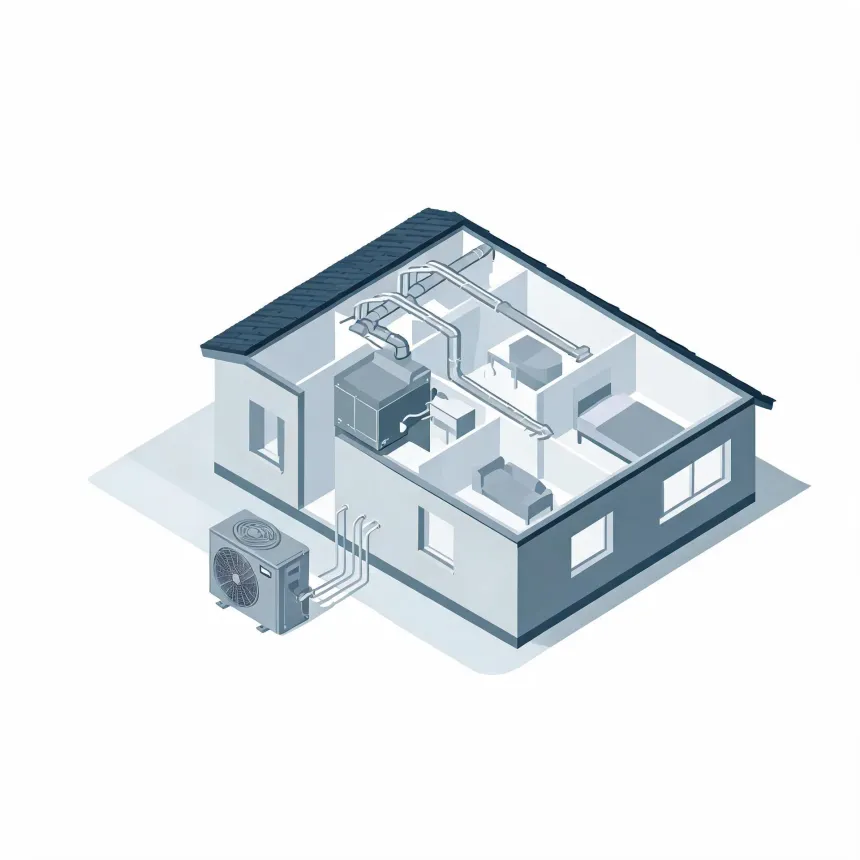
Isometric cutaway illustration of a single-story house showing interior rooms with ductwork, an indoor air handler unit, and an outdoor condenser unit connected by lines along the exterior wall.
Your system heats October through April and cools June through September.

NOAA nClimDiv, 1991–2020 normals

Half the homes in Bartholomew County were built in 1979 or later.

A heat pump that came with a newer house still has years in it, and that's usually a reason to fix it.

Electricity here runs 14.77 cents a kWh, so a heat pump limping along is burning money every day you wait

Power costs 14.77 cents a kWh statewide
40 damaging wind events from 2015 to 2024
10 winter storms from 2015 to 2024

September is the month to get a heat pump looked at, not October. Once homes here switch over to heat in October, the system is working hard right away, and a weak part that got through summer on easier duty often won't make it through the first cold stretch. The same thing happens in reverse each May, right before cooling starts in June. If your heat pump has been making a new noise or running longer than it used to, don't wait for the first cold snap to find out why.

Most of what breaks here is worth fixing

A worn part or a few years of skipped maintenance is usually what's behind a breakdown here, not a motor pushed past its limit. That points toward fixing it. Get it looked at and find out what's actually wrong before you decide anything.

Find a contractor
A man in a gray shirt and brown pants, seen from behind, carries a canvas tool bag up porch steps toward a blue front door beside a potted shrub.
A gray heat pump condenser unit mounted on a concrete pad against the gray lap-siding exterior wall of a house.

Know the age before you decide

If your heat pump came with the house and the house is newer, check the paperwork before you assume the worst. A unit installed within the last several years has a lot of running life still in it, and a repair call now is what gets you through the rest of it. That's true whether this is the first thing to go wrong or the third.

Check the thermostat and the power first

Make sure the thermostat is set to heat or cool as needed and the setting is actually past room temperature. Check the breaker for the indoor air handler and the breaker for the outdoor unit, since either one tripping will stop the system. Then walk outside. If the outdoor fan isn't spinning and you don't hear anything running, that's worth knowing before anyone comes out.
Look at the outdoor unit and the filter

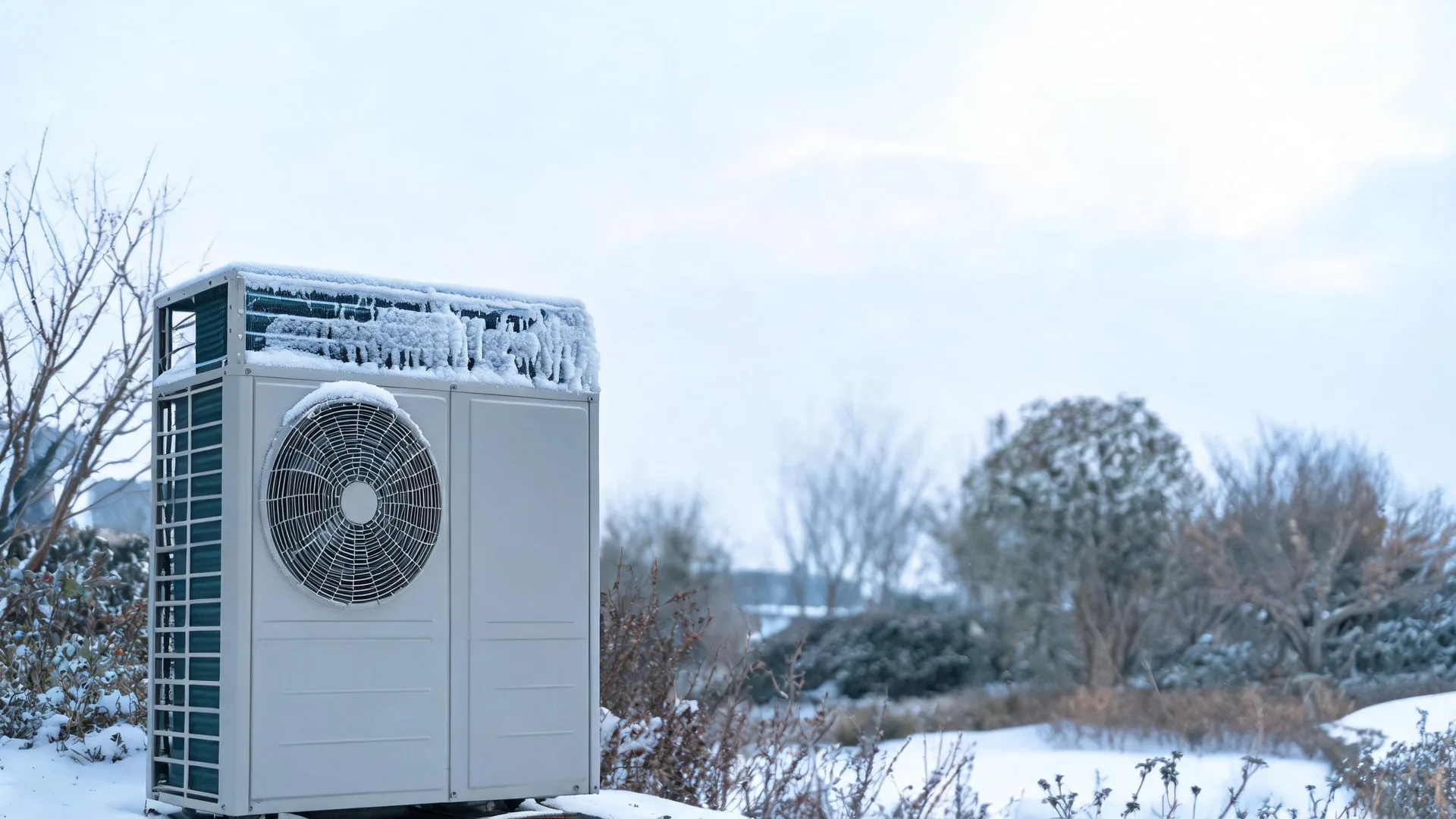
See if the outdoor coil is caked with ice or buried in leaves and debris. Some frost in winter is normal, but a solid block of ice usually means airflow is blocked somewhere. Pull the air filter and hold it up to light. If you can't see through it, swap it or clean it, since a clogged filter chokes airflow on both the heating and cooling side and can look like a bigger problem than it is.

A heat pump fails in a handful of predictable ways, and most of them trace back to one system doing both heating and cooling. The reversing valve is the part unique to a heat pump, and when it sticks, the system can get stuck blowing cold air when it should heat, or the other way around. The defrost cycle is another common culprit. It's supposed to melt off the frost that builds up on the outdoor coil in cold weather, and when the defrost sensor or control board fails, ice just keeps building until airflow stops. Low refrigerant charge shows up as weak heating or cooling and ice where it shouldn't be, and it almost always means a leak somewhere in the line, not just a top-off problem. The outdoor fan motor and compressor take the hardest hits since they run in every season, in every condition, and a failing capacitor is often what takes either one down. A dirty outdoor coil forces the whole system to work harder to move heat in both directions, which shortens the life of everything else.

A repair is usually the right call when the problem is one part acting up and everything else about the system still runs the way it should. A failed capacitor, a stuck reversing valve, a bad defrost sensor, these are jobs a tech fixes without touching the rest of the unit. Replacement starts to make more sense when the compressor itself is going, since that's the part that moves refrigerant through the whole system and it isn't a simple swap like a motor or a sensor. Age matters too, but not on its own. A heat pump that's needed a few different repairs over a couple of years is telling you something different than one that's never needed anything until now. The question worth asking isn't just what broke, it's whether the rest of the system is still in good shape to keep running once this one thing is fixed.