A row of dark-clad single-story cottages with gabled roofs behind trimmed hedges, with a mown lawn in the foreground and large leafy trees under an overcast sky.

Heat Pump Repair in Greencastle, IN

Tell us about the job

Takes about a minute. No obligation.

RepairHeat PumpPutnam County, IN
Step 1 of 2

What ZIP code is the job in?

Half these homes were built in 1981 or later

Putnam County splits close to down the middle on age. Half the houses here were built in 1981 or earlier, half in 1981 or later. If yours falls on the newer side, the heat pump probably isn't the original one either.


That changes the math on a repair

A newer heat pump with a bad capacitor or a stuck reversing valve is still a young machine having one problem. That's worth fixing, not replacing.

8 months
October through May, your system heats
3 months
June through August, it cools
22°F
the average winter night it heats against
83°F
the average summer afternoon it cools against
Isometric cutaway illustration of a small house showing ducted air distribution, an indoor air handler, and an outdoor condenser unit connected by lines, with a sofa and bed in the rooms.
Your system heats October through May and cools June through August.

NOAA nClimDiv, 1991–2020 normals

Greencastle winters hold around 22°F overnight, and summers ask plenty of a heat pump too, but neither one pushes the machine to its limit for long.

A heat pump that isn't overworked year after year is a better bet to repair when something goes wrong.

September is when a weak heat pump finally gives out

Cooling runs June through August
Heat runs October through May
51 damaging wind events from 2015 to 2024

Indiana homes paid close to 14.77 cents per kilowatthour in 2024, which is enough that a heat pump running badly costs you something every single month. A stuck reversing valve or a low charge doesn't strain the machine here, since it was never working hard to begin with, but it does make the machine run longer to hit the same temperature. Longer runtime at that rate adds up on the bill. Fixing it now stops the waste instead of paying for it all winter.

Get the heat pump looked at before it decides for you

If your heat pump came with the house, there's a good chance it's still a young machine. That's a repair worth making, not a system worth replacing. Get it looked at and find out what's actually wrong.

Find a contractor
A man in a cap, gray long-sleeve shirt and tan work pants carries a worn canvas tool bag up wooden porch steps toward a blue front door, with a potted shrub to the left.
A white mini-split heat pump outdoor unit mounted on a concrete pad beside a gray-sided house, surrounded by gravel and green shrubs.

It hasn't been running hard for years

A heat pump here isn't grinding through months of extreme heat or extreme cold back to back. That's the kind of use that wears out a reversing valve or a compressor early. When a repair call comes in on a machine that's had an easier run, the odds are better that it's one bad part, not the whole system failing at once. Worth finding out which one it is before deciding anything bigger.

A stuck reversing valve won't fix itself

When a heat pump gets stuck in one mode, the compressor keeps working against a system that's fighting itself. Left alone, that strain is what takes out the compressor, and a compressor is a much bigger job than a valve.

A low charge gets worse under its own weight

A refrigerant leak doesn't hold steady. Running the system low on charge makes the compressor work harder to move heat, and that extra strain is exactly what shortens its life. The leak doesn't grow because the machine ran, but the damage from running on too little charge does.

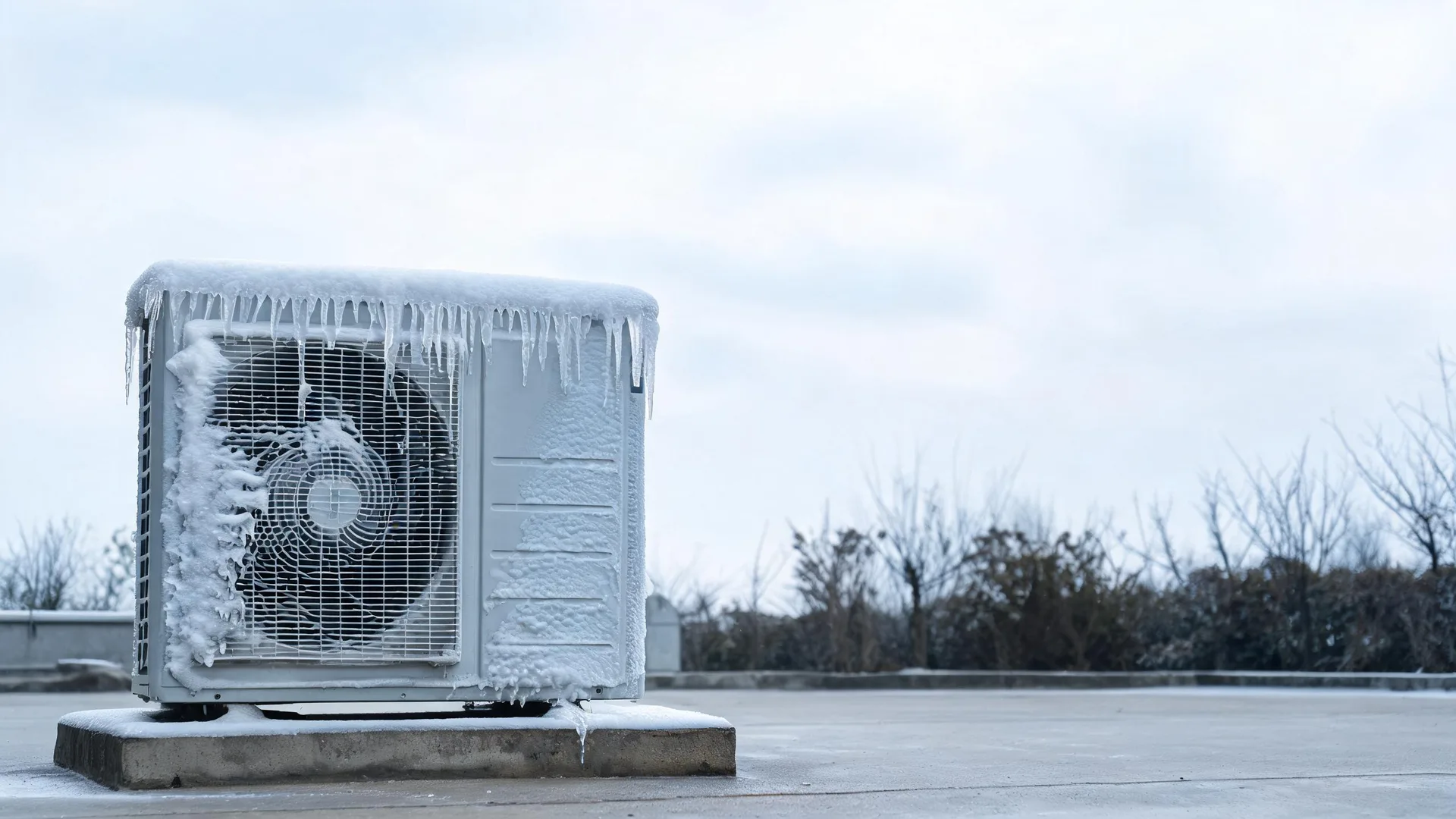
A failing heat pump usually tells you before it quits outright. Air coming out of the vents that feels barely warm in winter or barely cool in summer is the first thing most people notice. The system might run longer than it used to, or cycle on and off more than it should, or not shut off at all. Ice on the outdoor unit outside of a normal defrost cycle is worth paying attention to. A hissing or bubbling sound near the lines can mean a refrigerant leak. If the system switches between heating and cooling on its own, or won't switch when you need it to, that's usually the reversing valve. None of these fix themselves.

The question with any heat pump repair is whether the part that failed is the only thing wrong, or the first sign of something bigger. A capacitor, a contactor, a bad sensor, these fail on their own and fixing them brings the system right back to normal. A compressor is different. By the time a compressor is failing, it's usually because something else was wrong for a while first, low charge, a stuck valve, airflow that wasn't right, and the compressor was the part that finally gave out from the strain. That's why a tech checks more than the part that quit. Fixing a compressor on a system that still has the original problem just means you're back here again. A straightforward part failure on a system that's otherwise sound is almost always worth repairing.