A row of single-story houses with dark siding and gray shingled roofs behind large deciduous trees, with a trimmed hedge in the left foreground and a mown lawn under an overcast sky.

Heat Pump Repair in Michigan City, IN

Tell us about the job

Takes about a minute. No obligation.

RepairHeat PumpLaPorte County, IN
Step 1 of 2

What ZIP code is the job in?

September is worth watching

Heat in LaPorte County starts running in October, and September is when a heat pump that barely got through last winter will show it. A weak part doesn't usually fail sitting idle. It fails the first time the system has to work.


Catch it before the cold sets in

A heat pump struggling in September is only going to struggle more once the house needs real heat through the winter. Getting the cause found now, while the load is still light, means it's fixed before October through May put real demand on it.

8 months
October through May, your system heats
3 months
June through August, it cools
20°F
the average winter night it heats against
81°F
the average summer afternoon it cools against
Isometric illustration of a cutaway single-family house showing interior ductwork and an air handler, with an outdoor condenser unit connected by lines along the exterior wall.
Your system heats October through May and cools June through August.

NOAA nClimDiv, 1991–2020 normals

A diagnostic starts with the thermostat and the readings at the unit, not with guessing at parts.

Checking refrigerant pressure, airflow, and the reversing valve first means the right part gets replaced, not swapped out on a guess.

Indiana's power costs 14.77 cents a kWh, so a heat pump running wrong is a bill you'll notice

Power costs 14.77 cents a kWh statewide
60 damaging wind events from 2015 to 2024
32 hail events from 2015 to 2024
Half the homes here were built in 1969 or earlierAn older heat pump may be near the end of its life, and worth checking before it fails for good.

A heat pump that's short cycling or running nonstop doesn't know it's costing you anything. It just keeps pulling power to make up for a low charge, a stuck valve, a failing capacitor, whatever the real problem is. At 14.77 cents a kilowatthour, that extra draw shows up on the bill before the month is out. Waiting doesn't save anything if the unit keeps running worse. Get the diagnostic done and the right part swapped, and the draw goes back to normal.

Know what you're fixing before you pay for it

If your heat pump came with the house, find out where it stands before paying for a repair. A diagnostic will show whether the part that's failing is worth fixing or whether the whole unit is closer to done.

Find a contractor
A man in a cap, dark t-shirt and work trousers carries a canvas tool bag up porch steps toward a blue front door, with a tall planter and shrub beside the entry.
A dark gray heat pump unit mounted on a concrete pad next to a house with gray siding and a stone veneer wall.

What to check yourself before the diagnostic

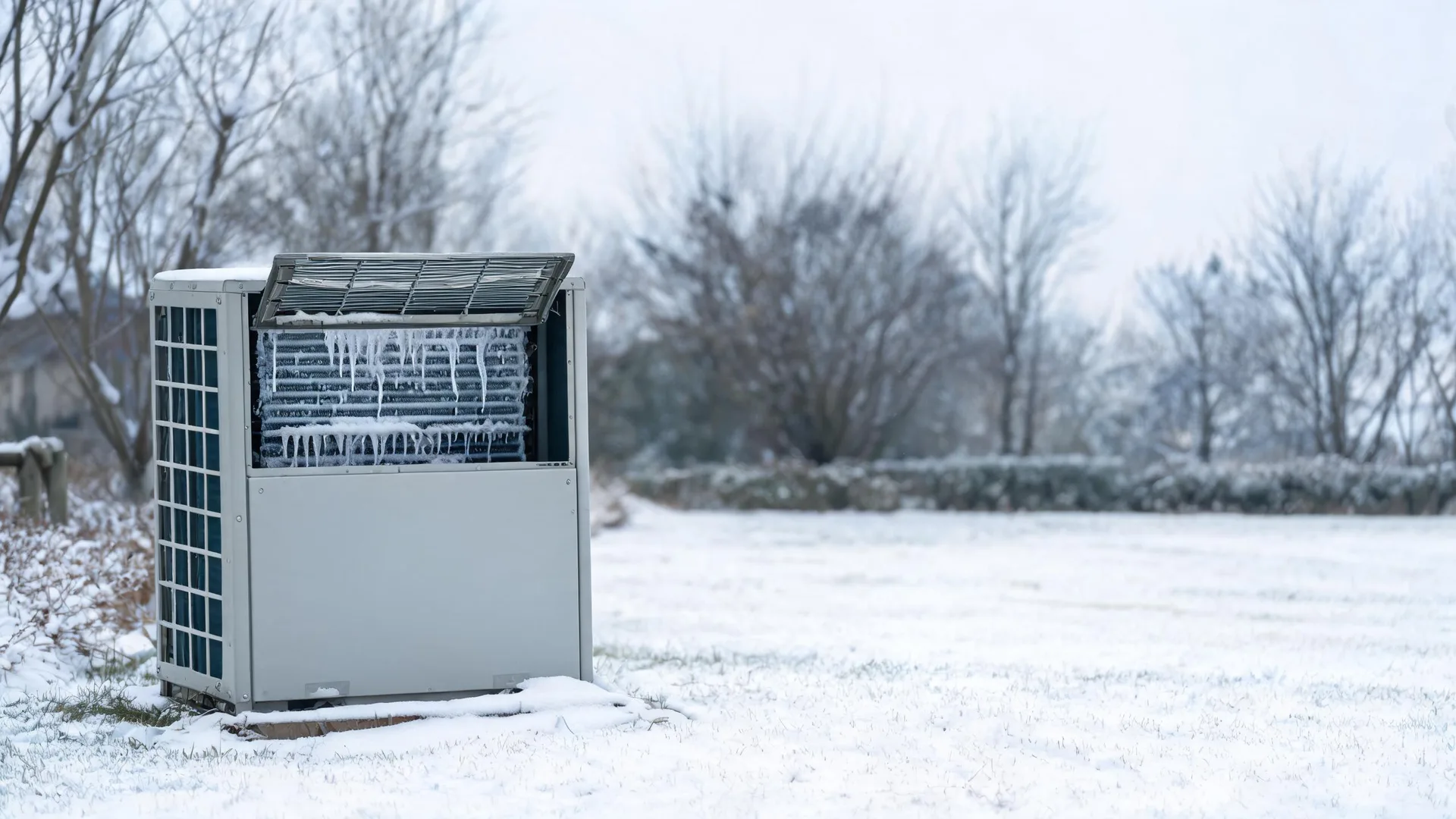
Before anyone comes out, walk outside and look at the outdoor unit. Clear away leaves, mulch or anything stacked against it, since a blocked unit can't move heat either direction. Check the filter next. A clogged filter starves the system of airflow and will make a heat pump run long and still underperform. Look at the outdoor coil for a heavy coat of ice. Some frost in defrost cycles is normal, but a solid layer that doesn't clear on its own points to a real problem. Inside, check that the thermostat is set to heat, not auto or cool, and that the batteries aren't the reason it went dark. Listen for what the system does when it starts up. Clicking that doesn't lead to the outdoor fan or compressor running is worth mentioning to whoever you call. None of this tells you what part is failing. It just rules out the easy stuff first.

A failing part works harder to cover for itself

When a capacitor weakens or a charge runs low, the system doesn't shut down, it compensates. The compressor runs longer to move the same heat. The fan runs more to make up for lost airflow. Every cycle that gets it through the day wears the parts that are already weak closer to the point where they stop working.

A small fault can take out a bigger part

A heat pump low on refrigerant will keep running, but the compressor was built to pump refrigerant, not run dry. Keep it going long enough under that condition and the compressor itself can fail. A leak caught early is a repair. The same leak ignored can end with the compressor gone too.

A heat pump that needs attention usually says so in how it runs, not with a warning light. It blows air that doesn't feel warm enough, or it runs long stretches without the house catching up to the thermostat. Short cycling is another sign. The system kicks on, shuts off quick, and kicks on again without ever settling into a normal run. Ice building up on the outdoor coil and staying there past a defrost cycle is worth paying attention to as well. So is a hissing or bubbling sound near the lines. That usually points to refrigerant escaping somewhere it shouldn't. Any new noise at startup is worth noticing too, a hum that never turns into the compressor running, or a clatter from the outdoor fan. The system is telling you a part is struggling before it quits outright.

Repair or replace usually comes down to the compressor. Every other part in a heat pump can be swapped without much thought, the capacitor, the fan motor, the reversing valve, the board. The compressor is the one part that costs enough and takes enough labor to change the math. If a compressor is failing on an older unit, most of the time the right call is a new system, not a new compressor. If everything else is sound and it's a capacitor or a motor that quit, that's a straightforward repair on a unit that still has years left in it. Age matters here too, not because a number says so, but because a heat pump nearing the end of its expected run is more likely to have a second part fail soon after the first one gets fixed.