






A gray forced-air furnace with ductwork stands in an unfinished concrete basement surrounded by storage items and clutter.

Furnace Repair in Jasper, IN

Tell us about the job

Takes about a minute. No obligation.

RepairFurnace or heatingDubois County, IN
Step 1 of 2

What ZIP code is the job in?

Furnaces in Jasper run about seven months a year, October through April, and nights in December and January average 25°F. That's steady use, but it's not unusual for a furnace. It's the same stretch of work a furnace does anywhere winter gets cold. So when one starts acting up here, it's almost always something ordinary. A failed igniter, a dirty flame sensor, a clogged filter cutting off airflow, a blower motor wearing out. A tech who works on furnaces sees these same problems over and over. The cold outside doesn't change what's usually wrong.

7 months
October through April, your furnace is on duty
25°F
the average winter night it heats against
7 winter storms
in ten years, the nights a failure hurts most
Isometric cutaway illustration of a single-story house with a dark shingled roof, showing interior rooms with furniture, ductwork, a flue pipe, and a furnace unit.
Your furnace works hardest from November through March.

NOAA nClimDiv, 1991–2020 normals

Furnaces in Jasper start running in October, after sitting idle since spring.

The first cold snap is when a weak igniter or a tired blower motor finally gives out.

Half the homes in Dubois County were built in 1980 or later

Half the homes here were built by 1980
Climate zone 4A
Heat runs October through April

A tech starts by asking what the furnace is doing, or not doing. No heat, weak heat, short cycling, a smell when it kicks on. Then the cover comes off and the burners get a look while the furnace runs through a cycle. The igniter should glow steady and the burners should light together, not one lagging behind the rest. A multimeter checks the igniter and the flame sensor against the readings they should hold. The flame sensor often gets pulled and wiped down, since a thin film of residue on it can make a furnace shut off seconds after it starts. The filter gets checked too, because restricted airflow can trip the limit switch and shut the whole thing down as a safety measure. If the blower is making noise or running at the wrong speed, that gets checked on its own. By the end the tech knows which part failed and why, not just that the furnace won't heat.

A furnace in a newer Jasper home is usually worth repairing

Half the homes in Dubois County were built in 1980 or later. If yours is one of them, the furnace likely hasn't logged enough winters to be worn out. When something fails, a repair is usually the right move before anyone talks about replacement.

Find a contractor
A man in a dark T-shirt and tan work pants, seen from behind, climbs porch steps toward a blue front door while carrying a canvas tool bag filled with hand tools.
A gray residential gas furnace installed in an unfinished basement, connected to sheet-metal ductwork and PVC pipes.

What actually wears out

A furnace wears out from running, not from sitting through a hard winter. Every time it fires up, the igniter heats up and cools down, and that cycling is what eventually cracks it. A flame sensor sits right in the burner flame each time the furnace runs, and over the months a thin coating builds up on it until it can't sense the flame anymore. There's no belt to worry about on a modern furnace. The blower fan is driven directly by the motor, so what gives out there is the motor itself or the bearings inside it. A capacitor that helps start the blower weakens gradually, cycle after cycle, then fails all at once with no warning. A furnace that runs a long stretch each winter is just putting more cycles on these same parts, which is why the usual failures show up here the way they do.

Check these before you call

Look at the thermostat first. Make sure it's set to heat and the set temperature is actually above room temperature. Check the furnace switch, the one that looks like a light switch near the unit, and make sure it's on. Look at the breaker for the furnace in the electrical panel. If the furnace has a standing pilot, check whether the pilot light is still lit. None of this takes tools, and any one of them can be the whole problem.

What the filter tells you

Pull the filter out and hold it up to a light. If you can't see light through it, it's restricted enough to cause trouble. A clogged filter starves the furnace of airflow, and that can trip the limit switch and shut the burners off before the house ever gets warm. Swapping in a clean filter is something you can do yourself, and if that was the problem, the furnace runs normally again right away. If it still won't heat with a clean filter in, the problem is past what you can check from here.

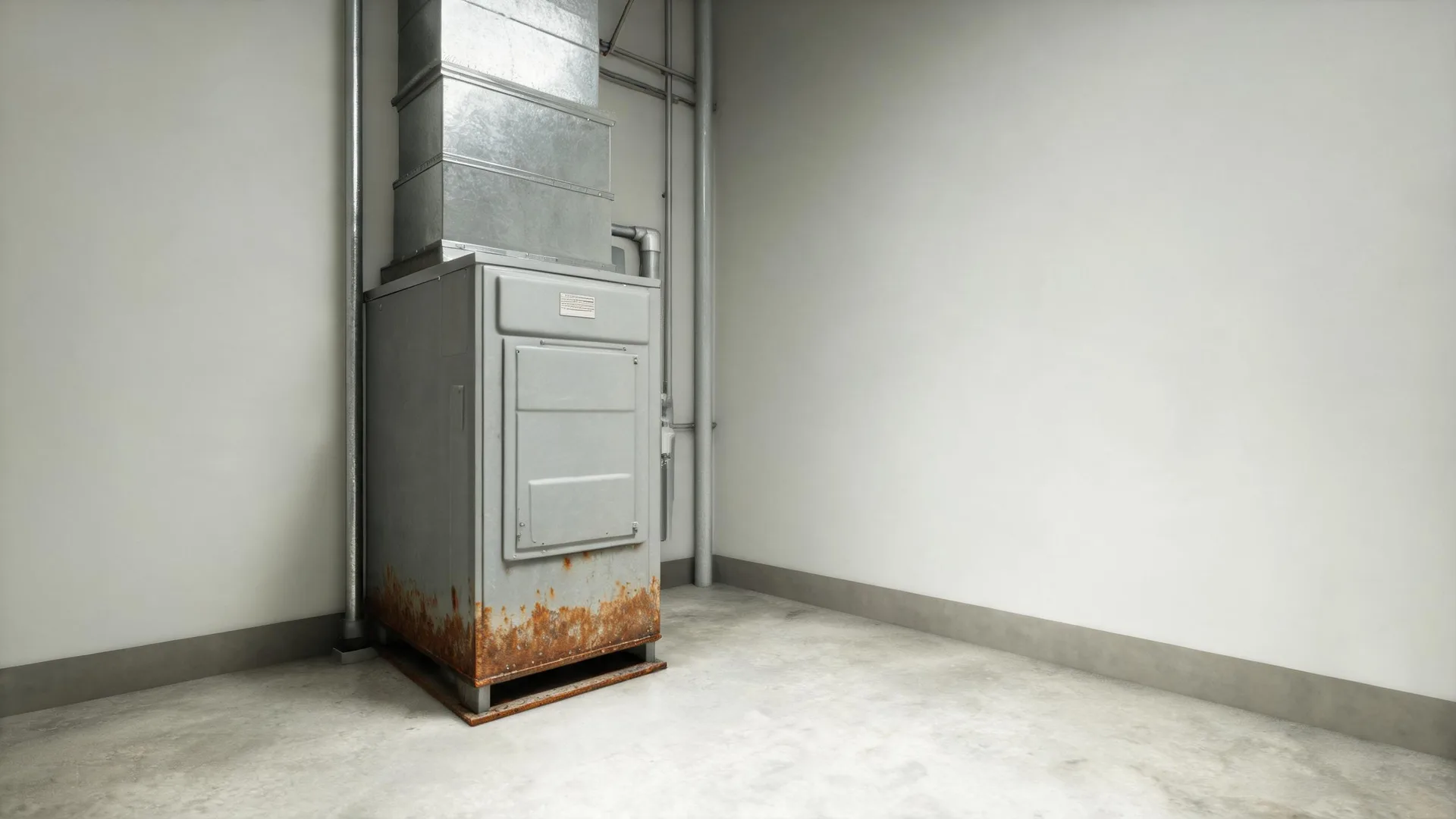
A gas furnace and sheet-metal air handler unit installed in an unfinished concrete basement.

A new furnace would cut about $90 a year off heating for a typical Dubois County home.

  • A new high-efficiency furnace$360 a year
  • An older furnace$450 a year

Estimates for a typical Dubois County home, compared with an older unit built to the previous federal minimum, from EIA household energy data, Indiana fuel prices and NOAA climate normals. Your home will differ.

Repair makes sense when one part has failed and the heat exchanger is sound.

Replacement makes sense when the heat exchanger is cracked or the furnace keeps needing parts.

A furnace failure doesn't always mean a decision about replacement. Most of the time a single part has failed, the igniter or the flame sensor or the blower motor, and swapping that part brings the furnace back to normal. The rest of the system, the heat exchanger, the gas valve, the ductwork, isn't touched by that kind of repair and isn't affected by it. Replacement usually comes up when the heat exchanger is cracked, since that's a safety issue and not something to patch, or when the same furnace keeps failing in different ways within a short stretch. A furnace that's heating fine between breakdowns and failing on one part at a time is still a furnace worth fixing.