





A row of dark-sided single-story buildings with gabled shingle roofs behind a tall trimmed hedge, with lawn, leafy trees and an overcast sky.

Heat Pump Repair in Jeffersonville, IN

Tell us about the job

Takes about a minute. No obligation.

RepairHeat PumpClark County, IN
Step 1 of 2

What ZIP code is the job in?

Heat pump season here runs October through April, with September the month to get ahead of it. October is when a weak part usually gets found. A capacitor that made it through summer cooling can fail once the system switches over to heat and starts cycling on more often. A contactor that's been arcing quietly does the same. If your heat pump is short cycling or struggling to keep up right now, the problem was probably already there, just waiting for the switch to heat to find it. Better to get it checked now than wait and have it quit in the middle of winter.

7 months
October through April, your system heats
5 months
May through September, it cools
26°F
the average winter night it heats against
86°F
the average summer afternoon it cools against
Isometric cutaway illustration of a single-story house showing interior ductwork, an indoor air handler and furnace unit, and an outdoor condenser connected by a line, on a white background.
Your system heats October through April and cools May through September.

NOAA nClimDiv, 1991–2020 normals

A reversing valve stuck in one position costs about as much to replace as a compressor costs to protect.

If the valve is the problem, fixing it now keeps the compressor from taking the damage instead.

Half the homes in Clark County date to 1982 or later

Half the homes here were built by 1982
79 damaging wind events from 2015 to 2024
38 hail events from 2015 to 2024
Jeffersonville heat pump repairIndiana homes paid 14.77 cents per kilowatthour in 2024, so a part worth fixing is worth fixing right.

Clark County gets its share of wind and hail, and a few tornadoes too, but that history doesn't point to why your heat pump is acting up now. Storm damage shows up in the outdoor unit or the power feeding it, not in the parts that simply wear out over time. If a breaker tripped during a storm and the system never came back on right, that's worth ruling out first since it's quick to check. Past that, you're looking at the same things that go wrong in any heat pump after enough run time. A failing capacitor. A dirty coil. A reversing valve that's stuck. The weather here doesn't change what's likely wrong. It's still a matter of finding which part quit and fixing that one.

A newer heat pump is still worth repairing

If your heat pump came with a house built in 1982 or later, it's got the age of half the homes in the county. That's not an old system. A part failing now is almost always a single part, not the system wearing out, and repair is the call that makes sense while the equipment underneath still has years in it.

Find a contractor
A gray outdoor HVAC unit mounted on a concrete pad beside a house with gray lap siding and a stone foundation.

The longer it runs like this, the more it wears on the compressor

A heat pump that's struggling doesn't fix itself by staying on. A weak capacitor makes the compressor draw harder every time it tries to start, and each hard start wears it down a little more. A system that's short cycling is stopping and restarting over and over, and that start-up draw is the hardest thing the compressor does all day. A dirty coil makes the whole system run longer to move the same heat, so a small airflow problem turns into hundreds of extra hours of strain over a season. The parts worth catching early are the ones feeding stress to the compressor, because the compressor is the one part in the system that can't be patched, only replaced. Left alone, a small part failing now is what takes the compressor down with it later.

What you'll actually notice first

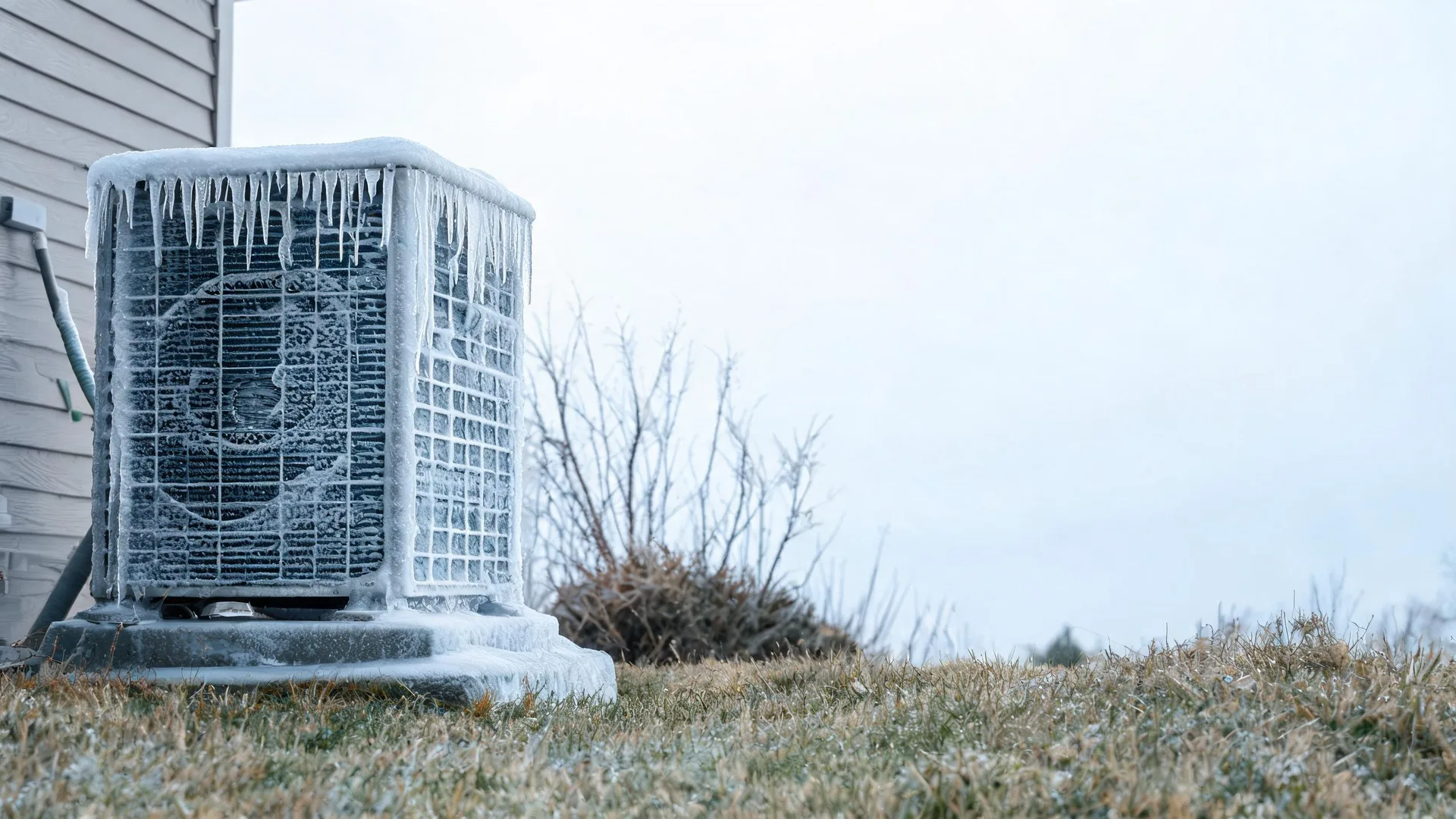
The air coming out feels wrong before anything stops working. Air that's lukewarm instead of warm, a unit that runs long stretches without shutting off, rooms that won't hold a set temperature no matter how long it runs. Ice on the outdoor unit that doesn't melt off during the defrost cycle is another one. None of these mean the system is dead. They mean one part is struggling to do its job, and the rest of the system is working harder to cover for it.
The noises worth stopping for

A click that doesn't lead to startup means the system tried and failed. A hard clunk when the unit switches between heating and cooling points at the reversing valve. A hum with no airflow behind it usually means the motor is drawing power but not turning. Grinding or squealing from the outdoor unit is bearings going bad. The machine is telling you which part to check, and waiting on it usually just turns one bad part into another.

Before anyone comes out, there are a few things worth checking yourself. Look at the outdoor unit and clear away any leaves, grass clippings or ice blocking the coil, since restricted airflow there can look like a much bigger problem than it is. Check the air filter inside and swap it if it's gray or clogged. Go to the breaker panel and confirm nothing tripped, including any separate disconnect box mounted near the outdoor unit. If you have a programmable thermostat, check that it's actually set to heat and not accidentally switched to cooling or fan only, and that the batteries aren't dead if it uses them. None of this fixes a bad capacitor or a stuck reversing valve, but it rules out the simple stuff first and gives the tech a clearer picture of what's actually wrong when they get there.

A diagnostic visit starts outside, not with a tool but with a look. A tech will check the outdoor unit's airflow, listen to it run through a cycle, and check the pressures in the line before touching anything inside. Most of the time, the symptom you noticed points to one part, and testing confirms it instead of hunting blind. A capacitor gets tested with a meter, not a guess, since a weak one can still spin the fan and fool you. Refrigerant pressures tell a tech whether the reversing valve is actually switching or just making the noise of switching. If the system short cycles, they'll watch it try to start again before they touch a single part, because how it fails tells them as much as what's failing. The visit ends with them naming the part, not the system, because a heat pump rarely goes bad all at once.